
How to Pay at Munich's Oktoberfest: The 2026 Rules
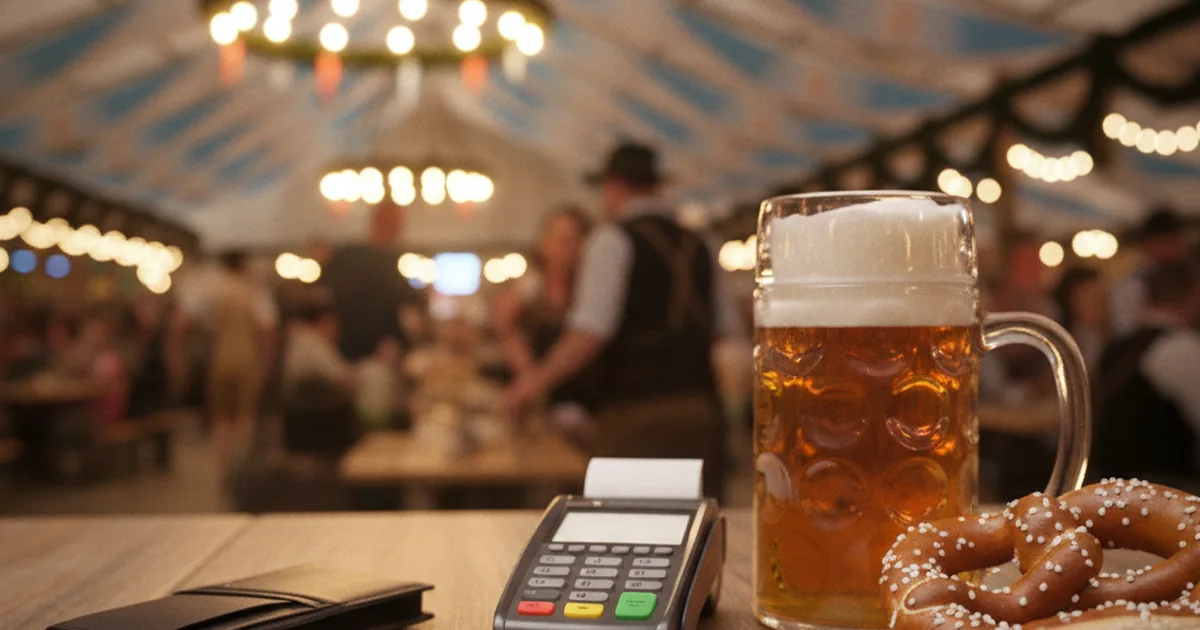
Paying at Munich's Oktoberfest is not something to figure out at the bar. In 2026, four of the big tents took cash only. In several others, "we take cards" meant EC-Karte, the German girocard, which does not guarantee that an international Visa card goes through. Arriving with a single way to pay is the easiest way to lose time hunting for an ATM in the middle of the festival.
The approach that works is to combine a card with a reserve of euros. Check which card network a place accepts before ordering, carry small notes for drinks and tips, and withdraw cash outside peak times. The rules change from tent to stall to ride.
The 2026 edition ran from September 19 to October 4, 2026. Entry to the grounds and the traditional tents was free, while the Oide Wiesn (the historic section) cost €4. This guide records the official 2026 payment rules and prices, rechecked in November 2026, after the festival. Use them as a baseline when planning a future visit, and check the official site again once the next edition's details are published: each operator can change what it accepts, and prices are set again every year.
Does Oktoberfest take cards, or is it cash only?
The short answer: it depends on the tent. The official Oktoberfest FAQ publishes a list of accepted payment methods, and it falls into three groups:
- tents that take cash only;
- tents that accept EC-Karte, or girocard;
- tents that also confirm credit cards.
For a visitor from abroad, the difference matters. EC-Karte is the old name still used for girocard, Germany's domestic debit system. A place that advertises Kartenzahlung (card payment) or EC-Karte may still turn down international Visa and Mastercard cards.
If the sign doesn't say "credit card", ask before you order:
Kann ich mit Visa zahlen?(Can I pay with Visa?);Kann ich mit Kreditkarte zahlen?(Can I pay by credit card?);Nur Barzahlung?(Cash only?).
How each Oktoberfest tent took payment in 2026
The table below follows the official FAQ's list for 2026. Fischer-Vroni does not appear in that list, so its row comes from the tent's own FAQ, which lists cash, EC card and credit card. Reconfirm with the tent before a visit.
| Tent | Payment methods listed | Credit card confirmed? |
|---|---|---|
| Armbrustschützenfestzelt | Cash and card, type not specified | Ask before ordering |
| Augustiner Festzelt | Cash only; ATM inside the tent | No |
| Bräurosl | Cash only | No |
| Fischer-Vroni | Tent FAQ: cash, EC and credit card | Reconfirm the current rule and the network |
| Hacker-Festzelt | Cash and EC/girocard | Not guaranteed |
| Hofbräu-Festzelt | Cash and EC/girocard | Not guaranteed |
| Käfer Wiesn-Schänke | Cash, EC and credit card | Credit confirmed; ask whether Visa is accepted |
| Kufflers Weinzelt | Cash and EC/girocard | Not guaranteed |
| Löwenbräu-Festzelt | Cash only | No |
| Marstall Festzelt | Cash, EC and credit card | Credit confirmed; ask whether Visa is accepted |
| Ochsenbraterei | Cash only | No |
| Paulaner Festzelt, also called Winzerer Fähndl | Cash and EC/girocard | Not guaranteed |
| Schottenhamel-Festhalle | Cash and EC/girocard | Not guaranteed |
| Schützen-Festzelt | Cash and EC/girocard | Not guaranteed |
Some smaller tents, such as Wildstubn, also list EC/girocard. Stalls, rides and shops set their own rules. The organizers say a good half of all booths and attractions now offer card payment, but that does not make the festival cashless.
Count on a Visa card only where the tent confirms Visa. If the rule just says "credit card", ask whether Visa is accepted before ordering. Apple Pay and Google Pay also depend on the networks the terminal accepts: a digital wallet does not turn a girocard-only terminal into a Visa terminal. See how to set up Apple Pay or Google Pay abroad (in Portuguese) without leaving your physical card behind.
How much cash to bring to Oktoberfest
There is no single figure, because food, rides and the length of your visit vary a lot. Rather than copying a generic budget, work out your cash from what you actually plan to consume.
In 2026, a one-litre Maß cost between €14.80 and €15.90, depending on the tent (the wine tent's wheat beer, priced separately, was more). The official averages for non-alcoholic drinks per litre were €11.13 for water, €12.84 for Spezi (a cola and orange soda mix) and €12.35 for lemonade. There were also ten free drinking-water fountains around the grounds.
Use this formula:
cash for the festival = drinks + food + rides + tips + a 20% margin
If your plan included two Maß in 2026, that meant €29.60 to €31.80 for the beer alone, before food and tips. If you don't drink alcohol, apply the same logic to water, soft drinks or lemonade. Check the tent's menu before your visit rather than assuming the previous year's prices.
A planning example
For a visit to a cash-only tent:
- multiply the number of drinks by the current year's price;
- add the food you pick from the tent's official menu;
- estimate rides or souvenirs paid in cash;
- set aside a few euros for tips;
- add 20% for changes of plan.
Do the math per adult. Don't hand the whole reserve to one person, and don't keep cash, card and phone in the same pocket. Our guide on how much money to bring on a trip helps you separate the festival budget from the rest of the trip.
Should you withdraw cash before or at Oktoberfest?
There are ATMs from various banks at the festival entrances and inside some tents. The organizers give an upper limit of €1,000 per withdrawal, but your bank, your card issuer and the ATM operator may set lower limits and charge fees.
Withdrawing at the festival works as a backup, not as the main plan. At busy times there can be queues, and the ATM screen may offer an unfavorable conversion. Arrive with your first batch of euros ready and use the ATMs at the entrances or in the tents only to top up.
At the ATM:
- choose EUR, the local currency;
- decline
conversion,guaranteed rate, BRL, USD or your home currency; - read the operator's fee before confirming;
- don't accept help from strangers;
- put the cash away before you leave the machine.
Visa explains that with dynamic currency conversion (DCC), the merchant or ATM must show the amount in both currencies, the exchange rate and any markup, must offer you the choice and must not choose for you. You can decline and continue in EUR. That applies at the ATM and at the card terminal. Our guide to ATM withdrawals abroad (in Portuguese) shows how to spot fees and pick the right option.
How does tipping work at Oktoberfest?
Tipping is common but not mandatory. Many people round up or add a few euros depending on the order and the service.
Say the total you want to pay when you hand over the money. If the bill is €31 and you want to pay €34, say vierunddreißig (thirty-four) or state the amount clearly. Don't wait for your change and then leave coins on the table, especially in a packed tent.
€5, €10 and €20 notes make paying easier and cut down on change problems. Avoid relying on large notes for a small order. Tips are part of the budget, but they don't need to follow a fixed percentage imported from another country.
Is there a deposit on the beer mug?
Don't add an automatic "mug deposit" to every Maß. The official 2026 pages did not publish a general deposit rule for the beer mugs served in the tents.
What matters is something else: the tent's mug is not a souvenir. The mugs belong to the tent operators and must stay in the tent, so don't try to walk out with one. The organizers point visitors to official souvenir stalls instead; the 2026 collector's mug cost €34.90, or €54.90 with a pewter lid.
Some operators do charge a deposit on returnable containers. The Oktoberfest sustainability rules, for example, say soft drinks are sold only in returnable bottles with a minimum deposit of €1. If you see Pfand (deposit) on the menu or receipt, ask where to return the container and how to get the money back. Don't assume that charge applies in every tent.
Does a table reservation change how you pay?
Booking a table carries no "reservation fee", but it usually requires buying food and drink vouchers in advance. According to the official reservation guidance, the package typically covers two litres of beer and half a roast chicken per person. Tables seat eight to ten people, and vouchers cost about €350 per table on average, with some tents charging more.
On top of the vouchers, the tent may charge actual shipping costs and a flat €1.50 per reserved seat for wristbands and other expenses. Under the official rules, no further costs of any kind may be charged. Check the total before you pay.
Prepaid vouchers cut the cash you need for what they cover, but they don't replace a way to pay for extras, tips, rides and anything outside the tent. Read three things in your confirmation:
- the amount and the items covered;
- where to pick up or present the vouchers;
- the rule for extra orders and any unused balance.
Don't buy a reservation from an unknown middleman. Reservations may not be resold; the organizers list each tent's official booking links and an official resale portal, and warn against unauthorized resale.
Does the Picnic card work at Oktoberfest?
New Picnic card orders are temporarily paused. According to the official notice (in Portuguese), first-time orders have been unavailable since September 22, 2026, with no confirmed reopening date. Existing cards keep working until December 20, 2026, at 23:59 UTC; after that, use continues through an upgrade to the card issuer's new infrastructure, which starts with the virtual card only, with no confirmed date for the physical card. After the upgrade, the card has to be added to Apple Pay or Google Pay again. What follows applies to people who already hold the card.
Picnic is a technology platform, and its card is a Visa card. It can work in the tents and stalls that confirm Visa. If a place only says "credit card", check the network before ordering. The card does not replace cash in cash-only tents, nor girocard where only the German system is accepted.
When you're charged in euros, choose EUR on the terminal and decline any offer to charge you in another currency. Picnic's fee table lists a 0% Picnic fee on purchases and about 0.3% for Visa's conversion on purchases in currencies other than the US dollar, and it recommends always paying in the merchant's local currency. Topping up the card by Pix carries a 0% Picnic fee and a 0.3%–0.5% provider cost. ATM withdrawals, available on the physical card, are free of Picnic fees for up to 5 withdrawals or US$200 per month, whichever comes first, then 2% per withdrawal; the ATM operator may add its own fee. The rate applied shows on the transaction and can vary. For the full breakdown, see Picnic card fees.
Before the festival:
- check your available balance;
- if you have a physical card, test it and your PIN;
- add the card to your digital wallet;
- keep a second card stored separately;
- carry enough euros for your base plan.
Your main card should never be your only card. Our guide to the best card to use in Germany (in Portuguese) helps you put together a combination for the hotel, transport and the rest of the trip. If you're deciding which card to keep as a backup, also compare debit and credit cards abroad.
Payment mistakes that ruin the day
Trusting the word "EC"
EC/girocard is not a synonym for any debit card. Ask specifically about Visa before ordering. If the answer isn't clear, pay cash.
Choosing your home currency on the terminal
Being charged in reais (or dollars) feels predictable, but it hands the conversion to the terminal operator. Choose EUR and let the card network do the conversion. See why paying in reais or in local currency (in Portuguese) changes the cost.
Withdrawing only once you're inside the tent
You may hit a queue, a bad connection or an unexpected limit. Have your base amount before you arrive and treat the tent's ATM as a top-up. If a card is refused anyway, our guide to a card declined abroad lists the usual reasons.
Relying on your phone alone
A digital wallet still needs the merchant to accept your card's network. The battery, your phone's settings and the terminal can all fail. Bring a physical card and cash.
Spending all your cash on the first round
Split your cash into blocks: tent, food, rides and the trip home. That keeps you from spending your transport or emergency money without noticing.
Checklist for paying at Munich's Oktoberfest
- Check the tent and its accepted payment methods on the official source.
- If you see EC-Karte, ask specifically about Visa.
- Budget drinks, food, rides, tips and a 20% margin.
- Carry small notes and split your reserve safely.
- Arrive with euros; don't depend on the ATM inside.
- At the terminal or ATM, choose EUR and decline DCC.
- Carry a physical card, a digital wallet and a backup card.
- Don't take the tent's mug; buy souvenirs at the official stalls.
- If you see
Pfand, ask how to return the container. - Recheck the rules close to your trip, because acceptance can change.
The best strategy is a hybrid one
How you pay at Munich's Oktoberfest depends more on the tent than on the card you bring. In 2026, Augustiner, Bräurosl, Löwenbräu and Ochsenbraterei were cash only. Käfer and Marstall confirmed credit cards on the official list, without naming a network. Fischer-Vroni's own FAQ lists credit cards too, so reconfirm it for your visit. In the remaining tents, EC/girocard may not include Visa.
Plan your visit in three layers: euros for what you expect to consume, a Visa card where the network is confirmed, and another way to pay kept aside as a backup. Use the current year's prices to do the math, carry small notes and decline any conversion to your home currency.
If you already have a Picnic card, check the balance and the rate in the app before you travel. If you don't, check current card availability (notice in Portuguese) before planning around it. At Oktoberfest, though, the best saving starts with one simple rule: check how the tent takes payment before you order.
Picnic is a technology platform that lets users independently interact with USDC, a U.S. dollar-pegged stablecoin issued by Circle, on public blockchains. USDC is not legal tender in Brazil.
Displayed exchange rates vary with market conditions. The final applicable amount is the one shown on the transaction confirmation screen. Cryptoassets involve risks, including volatility and loss of peg.
Picnic does not custody user assets and is neither a financial institution nor a virtual asset service provider. Sending and receiving U.S. dollar payments through a U.S. account is offered in partnership with Noah Savings Inc. Terms and conditions apply.
Information verified in November 2026.

Picnic team
Technology platform
The Picnic team creates content about international finance, cards and digital dollars.
Get your Picnic card
No annual fee, no IOF and no Picnic fee. Open your account in five minutes.
Open your account →