
Debit or Credit Card Abroad: Which One to Use
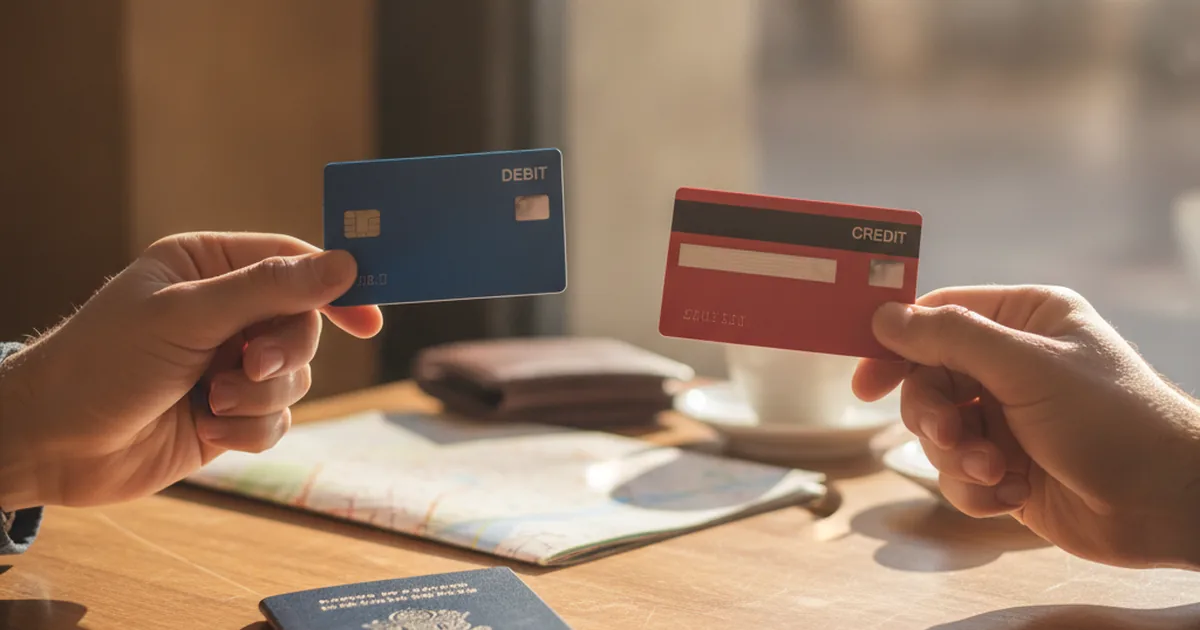
For years, travelers heard the same advice: abroad, use your debit card, because it is cheaper than credit. That advice has aged. Since July 2025, IOF (Brazil's tax on financial transactions) has been unified at 3.5% for purchases and card loads that go through the traditional foreign-exchange route, whether on credit, debit or prepaid. If your decision between a debit or credit card abroad still rests only on the card type, it starts from a premise that no longer holds.
The question still matters, but for other reasons. Exchange rate, spread, fraud protection, cash withdrawals and spending predictability are what separate debit from credit today. And when you look at the real cost of a trip, you find that the variable that weighs most is not even that choice. It is how many times you convert currency and how much you pay each time.
Picnic is a technology platform that has operated globally since 2021 and offers, in Brazil and Europe, an international account with a Visa card linked to a digital-dollar balance. The data in this article was checked in November 2026.
New Picnic card orders are temporarily paused. According to the official notice, first-time card orders have been unavailable since September 22, 2026, and there is no confirmed date for them to reopen. Separately, the current card version keeps working until December 20, 2026, at 23:59 UTC; after that, use continues through an announced upgrade to the new infrastructure, starting with the virtual card. There is no confirmed date for the physical card in the new version. The Picnic examples in this guide apply to people who already hold an eligible card.
Debit or credit abroad? The short answer in 2026
On cards that go through the traditional exchange route, international credit and debit pay the same 3.5% IOF. The right choice depends on what you value most on the trip.
- Use debit or prepaid as your main method to keep spending under control and avoid an unpredictable bill after the trip.
- Bring credit as backup for hotel and car-rental deposits, emergencies and places that do not accept debit.
- Also compare the route used to load the balance. A card linked to digital dollars, such as Picnic's, works outside the traditional exchange route and currently does not charge IOF.
The most practical combination, then, does not require picking a single winner: debit for everyday spending, credit as backup.
The rest of the article breaks down each of these points with updated numbers.
What changed: 3.5% IOF on the traditional exchange route
IOF is the Tax on Financial Operations that the Brazilian government charges, among other things, when a Brazilian buys foreign currency or spends in a foreign currency. For a long time, the rate varied by type of operation, and that is where the debit advantage came from.
The rate is the same for both
That is over. Since July 2025, after a Supreme Federal Court (STF) justice reinstated Decree No. 12,499/2025, the IOF on the main foreign-exchange operations for individuals has been unified at 3.5%. The same rate applies to international credit card purchases and to the conversion used to load debit or prepaid cards in foreign currency, as well as to buying cash currency and to withdrawals made through the traditional exchange route. The rule is in Decree No. 12,499/2025.
In practice, the old reasoning that "debit pays less IOF than credit" no longer applies within the traditional exchange route. Both pay 3.5%.
The reduction schedule to 2028 is no longer in force
There was a plan to gradually reduce IOF on international purchases until it reached zero in 2028. That schedule is no longer in force. So when you plan a trip today, the number to work with is 3.5%, without counting on future reductions that are not guaranteed. If a guide says the tax keeps falling until 2028, it is out of date.
What changes is when the tax is charged
The rate is the same, but when IOF enters your life differs between the two:
- On credit, IOF applies to each transaction, and you see it itemized on your bill, along with the exchange rate used to convert each purchase.
- On debit and prepaid, IOF is charged at the time of conversion, that is, when you load the balance in foreign currency. After that, spending comes out of the amount already converted.
This difference in timing has an important side effect on cost, which we will see further on.
Credit card abroad: pros and cons
The credit card is the most widely accepted payment method in the world and the one with the most robust safety net. These are attributes of the card network and of credit as a product, and they apply regardless of which bank issued your card.
Pros:
- Acceptance and deposits. Hotels and car-rental companies almost always ask for a credit card to pre-authorize a security deposit. Many do not accept debit for this at all.
- Fraud protection and chargebacks. If the card is cloned or a purchase is not recognized, the issuer usually disputes and reverses it. If the card is lost or stolen, blocking it and getting a replacement card tend to be quick.
- Room for emergencies. An available credit limit covers a large unexpected expense without depending on the balance you loaded.
Cons:
- No control over the exchange rate. On credit, each purchase is converted at the rate of the transaction date, under Central Bank rules. That is better than the old practice of converting at a later billing-date rate, but you are still exposed to the currency's movement on the day you spend, without being able to choose the best moment to exchange in advance.
- Easier to overspend. Without a ceiling tied to your balance, it is easier to blow the travel budget.
- Issuer spread. On top of IOF, most Brazilian credit cards build in their own exchange spread, which we look at below.
International debit card abroad: pros and cons
The international debit card, and its cousin, the foreign-currency prepaid card, works from a balance you load before using it. Is it worth it? It depends on what you are looking for.
Pros:
- Exchange-rate predictability. When you load dollars or euros, you lock in the rate at that moment and use that balance for purchases, without depending on how the currency moves during the trip.
- Spending control. You only spend what you loaded, which helps you stay on budget without surprises.
- Withdrawals abroad. It is the usual way to take cash out of ATMs abroad, useful where cash is still common. It is worth understanding how ATM withdrawals abroad work beforehand, because the local network usually charges its own fee per withdrawal.
What needs attention:
- Preloaded balance. You need to load the amount before spending. That creates a natural limit for the trip, but requires keeping an eye on the available balance.
- IOF paid up front. Because the tax applies on top-up, you pay the 3.5% when you load, on the full amount loaded, even if you end up not spending all of it.
- Limited deposit acceptance. Not every hotel or car-rental company accepts debit for a security-deposit pre-authorization.
That first limitation is also debit's main advantage: without an open credit line, you do not turn an impulse purchase into debt. What looks like a lack of flexibility becomes budget predictability.
What really drives the cost (it is not debit vs. credit)
Here is the point almost no guide puts at the center. Once IOF became the same for both, what separates an expensive trip from a cheap one is the exchange spread and the number of conversions you make.
The spread is the margin an institution adds on top of the real exchange rate when it converts your money. On many Brazilian cards, credit or debit, this spread is commonly around 2% to 6%, depending on the issuer (some charge less), and it comes on top of the 3.5% IOF. It is a cost that often does not even show up clearly, because it is built into the conversion rate.
And there is a second, quieter layer: each purchase in a foreign currency is a new exchange operation. On a ten-day trip with dozens of small purchases (restaurant, transport, shop, supermarket), IOF and spread apply again to each one of them. It is the same logic we explain in the guide on paying in reais or in local currency: the more conversions, the higher the total cost.
Run the numbers with an example. On a US$3,000 trip to a destination that does not use the dollar, at an illustrative rate of R$5.50 per dollar (about R$16,500), the 3.5% IOF alone is about R$577. Add a 4% spread and that is another R$660. That is over R$1,200 in extra cost, and the amount is practically the same whether you choose debit or credit, because the tax difference between them no longer exists.
The third option: spending from a dollar balance
There is a route that is not quite "debit vs. credit": keeping a dollar balance and spending from it. The idea is to handle the conversion once, when the rate suits you, and then spend without turning each purchase into a new exchange operation.
The Picnic Visa card is linked to a digital-dollar balance. It works at merchants that accept Visa in more than 180 countries, but not in restricted countries and regions (list in Portuguese). According to the official Picnic fee table, loading the card by Pix has zero Picnic margin and no IOF; the quote includes a provider cost of between 0.3% and 0.5% relative to the reference rate, shown before you confirm. That means funding is not free just because Picnic's own margin is zero. Once loaded, the balance pays no additional Picnic fee on purchases in dollars. On purchases in other currencies, Visa does the conversion and applies about 0.3%. ATM operators may charge their own fees separately. It is worth comparing with what your bank offers by reading how an international card works.
On the regulatory side, BCB Resolution No. 521/2025 classified certain transactions with fiat-referenced virtual assets as foreign exchange, and whether 3.5% IOF applies to card transactions in this category still depends on complementary regulation. The current no-IOF treatment reflects today's conditions; recheck it before traveling rather than assuming it is permanent.
In the same US$3,000 example at a destination outside the dollar, the combined cost of loading plus Visa's conversion would come to roughly R$99 to R$132, against more than R$1,200 on the traditional route. This is an approximate calculation, not a quote: the exact rate and route shown in the app govern. In the United States, where the purchase is already in dollars, the cost is concentrated in the initial load, as we detail in the guide on the best card to use in the US. In destinations that use other currencies, such as Europe, the logic of keeping a single balance still holds, and it is worth also reading about the best card to use in Europe.
None of this is "dodging tax". The difference is structural: spending dollars you have already converted is not the same as making a new exchange operation with every purchase. If you want, you can leave that dollar balance earning a variable yield automatically in Picnic's Caixinha Protegida until it is time to use it, redeeming to the card when you need it.
Comparison table: credit vs. debit vs. dollar balance
| Criterion | Credit card | Debit / prepaid card | Dollar balance (Picnic, existing cardholders) |
|---|---|---|---|
| IOF on international purchases | 3.5% | 3.5% on a traditional top-up | 0% in Picnic's current flow |
| Exchange spread | Issuer spread (~2% to 6%) | Issuer spread (~2% to 6%) | Zero Picnic margin; provider cost of 0.3% to 0.5% on the load and ~0.3% from Visa only for currencies other than USD |
| Conversions | One per purchase | One per top-up | One on the way in; purchases come out of the balance |
| Cost on purchases in the US (USD) | IOF + spread | IOF + spread | No additional fee on the purchase; loading by Pix has a provider cost of 0.3% to 0.5% |
| Fraud protection | Strong | More limited | Visa network |
| Hotel/car-rental deposit | Almost always accepted | Not always accepted | May not be accepted when the merchant requires credit for a deposit |
| Exchange-rate predictability | Lower (rate on purchase date) | Higher (locked at top-up) | High (you convert when you choose) |
Issuer spread figures vary by institution; use your own card's figures for an exact calculation. Data checked in November 2026.
How to decide for your trip
In practice, the answer is not to pick one and drop the other, but to put together the right combination:
- Use a card linked to a dollar balance for restaurants, transport and everyday purchases. That volume of transactions is where IOF and spread can pile up.
- Bring a credit card for hotel and car-rental deposits, emergencies and merchants that require credit. It works as backup; it does not need to be your main method.
- Use debit/prepaid or ATM withdrawals only where you need cash, aware of the local withdrawal fee and of IOF paid up front on a traditional top-up.
If you are also thinking about paying by other methods abroad, such as QR codes, it is worth reading the guide on Pix abroad, which follows the same cost-per-conversion logic. And to set up your dollar balance before boarding, see how a dollar account for Brazilians works.
Frequently asked questions
Does debit or credit have less IOF abroad? On the traditional exchange route, neither. Since July 2025, IOF has been 3.5% on credit and on loading debit or prepaid cards in foreign currency. Digital-dollar flows, such as Picnic's current one, follow a different structure and currently have no IOF; that treatment depends on pending regulation and should be rechecked before you travel.
Is an international prepaid card worth it? It is if what you want is to lock in the rate and control spending. But it pays the same 3.5% IOF on top-up and usually carries an issuer spread. Spending from a dollar balance without its own spread tends to be cheaper for repeated use.
Can I travel with only a debit card? It is possible, but not ideal. Without credit, you may struggle with hotel and car-rental deposits. Combining debit for spending with credit as a reserve reduces that dependence.
Which is safer abroad? Credit usually offers easier disputes and chargebacks in case of fraud, plus fast blocking and replacement cards. That is why it is a good reserve in your wallet, even if it is not your main way to spend.
Conclusion
Three things to take from this read. First: on cards that go through the traditional exchange route, debit and credit abroad pay the same 3.5% IOF, so the old advice to "use debit because it pays less tax" no longer applies. Second: debit's main limitation, spending only the available balance, also helps keep your budget under control. Third: you do not need to choose just one type. A dollar balance for everyday spending and credit as backup make a more complete combination.
Before you board, run a simple simulation: take what you plan to spend and compare the cost of converting with each purchase against spending from a dollar balance you have already converted. The difference often pays for a night's stay or a dinner. If you already hold a Picnic card, check the current Picnic quote for your dollar balance before the trip and compare it with your other cards. New card orders are paused, so people without a card should check the official notice for updates.
Picnic is a technology platform that lets users independently interact with USDC, a U.S. dollar-pegged stablecoin issued by Circle, on public blockchains. USDC is not legal tender in Brazil.
Displayed exchange rates vary with market conditions. The final applicable amount is the one shown on the transaction confirmation screen. Cryptoassets involve risks, including volatility and loss of peg.
Picnic does not custody user assets and is neither a financial institution nor a virtual asset service provider. Sending and receiving U.S. dollar payments through a U.S. account is offered in partnership with Noah Savings Inc. Terms and conditions apply.
Information verified in November 2026.

Picnic team
Technology platform
The Picnic team creates content about international finance, cards and digital dollars.
Get your Picnic card
No annual fee, no IOF and no Picnic fee. Open your account in five minutes.
Open your account →