
US Bank Account for Brazilians: No US Residency and No SSN
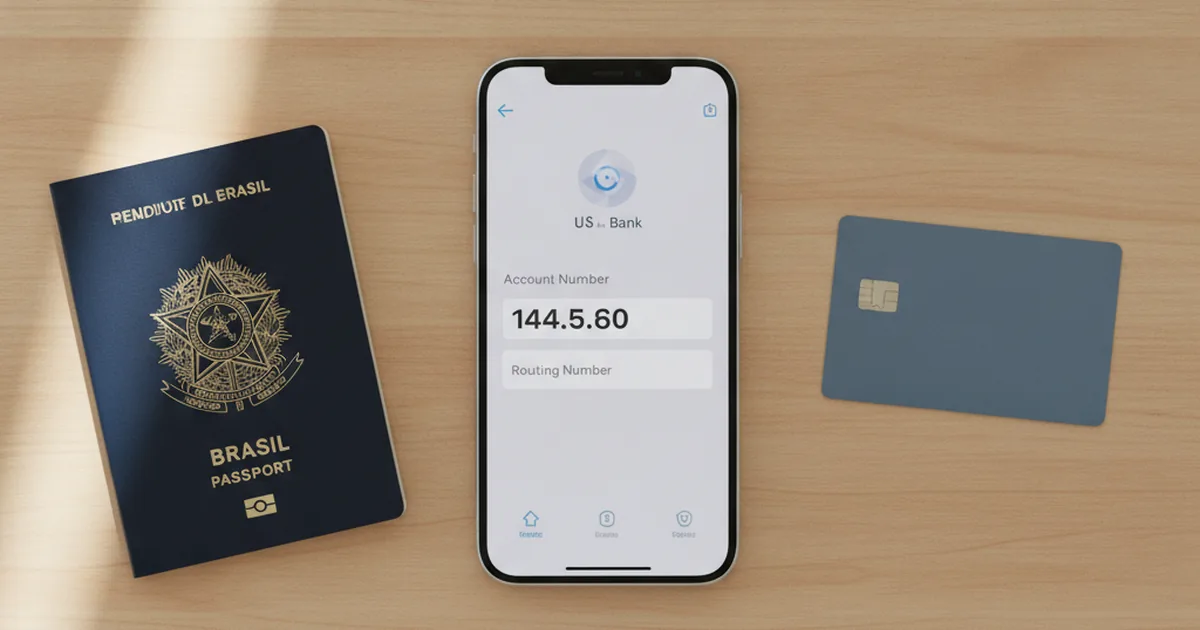
You don't need to live in the United States, or to have a Social Security Number, to receive dollars like a local. That is the part almost no guide makes clear. Most of them start by listing US banks and residency requirements, and drop out of the conversation before answering what really matters: what you want to do with the money once it arrives.
This guide separates things that often get mixed up. A "US bank account" can mean three quite different things, with quite different costs. We'll look at the three routes, what each one really costs and where the fee that eats into your dollars without showing up on your statement actually sits.
What you actually want when you ask for a "US account"
Before choosing a route, it helps to understand the goal. A Brazilian usually looks for a US bank account for one of three reasons:
- Receiving dollars from a client, a platform (Upwork, Deel, Stripe, PayPal) or a company that pays in USD.
- Holding dollars as a reserve, away from the depreciation of the Brazilian real.
- Spending in dollars on international purchases, subscriptions and travel.
The good news: for all three, you almost never need an account at a brick-and-mortar US bank. What works in practice is having US bank details (an account number and a routing number) to receive payments, plus a dollar balance that you control. For a broader look at the options, see our article on dollar accounts for Brazilians (in Portuguese). Living in the US and having an SSN only matter if your goal is to build credit and become a full customer of a traditional US bank, which is a different story.
Do you need an SSN? No. Meet the ITIN
The Social Security Number is the tax and social security ID of people who work in the US. A Brazilian who doesn't live there won't have one, and doesn't need one to access basic financial services.
The substitute is the ITIN (Individual Taxpayer Identification Number), a nine-digit tax number issued by the US tax authority, the IRS, to people who need a US taxpayer number for federal tax purposes but are not eligible for an SSN. The ITIN is for tax purposes only: it does not authorize work in the US or change immigration status. When a traditional bank asks for a taxpayer number from a non-resident, the ITIN is the usual alternative to the SSN, but each bank sets its own rules.
The point is: you don't always need an ITIN either. It depends on the route you choose.
The three routes to holding dollars like a local
Route 1: a traditional US bank
Chase, Bank of America, Wells Fargo. This is the "US account" in the classic sense: branches, a debit card, checks and the chance to build a credit score over time.
The barrier to entry is the highest. You will usually need an SSN or ITIN and a US address (even if it's only for receiving mail). Some banks let you open an account with a passport and a US address, but doing it remotely from Brazil is bureaucratic and often requires an in-person visit to finish.
Makes sense for: people who are moving to the US, want to build credit and become full customers of a local bank. If that's you, also see the guide to cards for Brazilians living in the US and the breakdown of moving costs (both in Portuguese).
Route 2: a fintech with a USD account
Wise, Avenue, Revolut and other fintechs offer a 100% digital dollar account, opened in an app with documents from your own country. You activate USD and get an account number and a routing number to receive payments via ACH (the US domestic transfer system, which usually takes one to three business days and is generally free or low-cost for the sender, depending on their bank) or by wire.
Some of these accounts are held at US banks covered by FDIC deposit insurance, whose standard limit is US$250,000 per depositor, per insured bank, per ownership category. Avenue, for example, says its checking account has been held since May 2026 at Coastal Community Bank, an FDIC member (it was previously at Evolve Bank & Trust); partner banks can change, so check the current partner and coverage in the provider's own disclosures before you sign up.
Makes sense for: people who want a simple digital account with US bank details and accept the platform's custody model. Pay attention to the conversion cost when you move the money out, because that's where the fee sits (more on this below).
Route 3: US bank details to get paid like a local, without residency
This isn't about opening an account at a physical bank or becoming a resident. You get US bank details so that a client or platform in the US can pay you as if it were a domestic payment, and the dollars land in a balance you control. No SSN, no US address, no move.
This is Picnic's model. You receive dollars with US bank details provided through a partner (Noah) and keep the balance in digital dollars, ready to spend on the card or to hold while earning yield. Picnic is a technology platform, not a bank, and uses a self-custody model in which you keep control of your assets.
Makes sense for: freelancers, service providers and anyone who earns in dollars and wants the lowest possible total cost to receive, hold and spend, without residency paperwork.
The detail almost nobody mentions: the cost of converting your dollars
All three routes deliver dollars. The real difference shows up when you move that money.
The dollars arrive as dollars. But when it's time to use them, many people convert to reais and then back again, or spend with a Brazilian card that converts everything again. That's where two tolls come in:
- IOF (Brazil's tax on financial operations): in 2026, the IOF rate on foreign exchange for sending money to an account abroad and for loading an international card is 3.5% (Decree No. 12,499/2025). The gradual reduction schedule that had been planned for the coming years was revoked, so don't count on an automatic drop. Converting dollars that come in from abroad into reais generally carries a lower rate (0.38%). To understand where IOF applies, see what IOF is (in Portuguese).
- Spread: the margin built into the exchange rate. It doesn't show up as a line on your statement, but it disappears from your balance. It ranges from close to zero to more than 3% depending on the platform.
On a R$5,000 conversion, 3.5% IOF is already R$175 before any spread. If you receive dollars every month and convert back and forth, that cost repeats every time.
The way to avoid it is simple: don't convert back. Receive in dollars, hold in dollars and spend in dollars. This is exactly where Route 3 parts ways with the others.
How receiving dollars works on Picnic
On Picnic, you receive dollars with US bank details, without living in the US and without an SSN. After a quick identity check in the app, you get your own receiving details: account holder name, bank (Lead Bank, the US partner bank), ACH routing number and account number. See where to find your dollar account details.
The money lands in your digital-dollar balance without being converted into reais, so there is no spread and no IOF on the way in. As of November 2026, Picnic's fee table lists a 0% Picnic fee on ACH deposits, with a processing adjustment of up to US$0.0005 per deposit; the sending bank may charge its own fee.
A few rules to know before you share your details:
- The account accepts ACH and domestic US wires. International wires sent from outside the US and SWIFT transfers are not accepted (accepted methods).
- Noah sets no fixed cap on how much you can receive, but some transfers may be reviewed and require supporting documents (receiving limits and rules).
- Availability depends on account approval, and the Help Center currently ties the dollar receiving account to the dollar version of the Picnic card, so check in the app whether the option is available to you.
From there, you have two choices that cover "spending" and "holding" without converting back:
- Spend directly with the Visa card in dollars. The Picnic card is accepted in more than 180 countries where Visa is accepted, with no annual fee. When you spend in dollars, the cost is 0% (there's no conversion, so no spread and no IOF). On purchases in other currencies, Visa's conversion costs about 0.3%, still without IOF. No loading the card in reais and paying 3.5% IOF before you spend.
- Hold it and earn yield in Protected Savings (Caixinha Protegida). If the dollars will sit as a reserve, you can leave them earning automatically in Picnic's digital dollar, and withdraw at any time. The current rate is shown in the app. To dig deeper into how dollars earn yield inside Picnic, see dollar accounts that earn yield (in Portuguese).
Card availability: new Picnic card orders have been temporarily paused since September 22, 2026 (notice in Portuguese), with no confirmed date for reopening. Existing cards keep working normally until December 20, 2026, at 23:59 UTC; after that, cardholders continue on Gnosis Pay's new infrastructure through an upgrade in the app, which starts with the virtual card (the physical card has no confirmed date yet). The card benefits above apply if you already have the card; otherwise, check current card availability before planning around it.
If you're a freelancer who gets paid from abroad, it's worth working out how much you're losing on conversion today. The guide on how to receive in dollars while living in Brazil (in Portuguese) walks through the math in detail.
Comparing the three routes
| Route | Need an SSN? | Need to live in the US? | Receive via | Cost of converting the USD |
|---|---|---|---|---|
| Traditional bank (Chase, BoA) | SSN or ITIN | US address required | ACH / wire | Depends on the bank when you withdraw or convert |
| USD account fintech | No (Brazilian documents) | No | ACH / wire | Spread when converting, plus IOF (3.5% from BRL to USD; 0.38% from USD to BRL) |
| US bank details on Picnic | No | No | Domestic ACH / US wire | 0% Picnic fee to receive; 0% to spend in USD with the card |
IOF rates checked in November 2026 (Decree No. 12,499/2025). Costs on other platforms vary by provider and by transaction; check the current terms before choosing.
When each route makes sense
There's no single answer. It depends on what you'll do with the dollars.
If you're moving to the US and want to build local credit, a traditional bank is the final destination, even with the SSN or ITIN and US-address paperwork. It's worth starting there calmly.
If you want a multi-currency digital account with broad coverage and FDIC insurance on the balance, a USD account fintech delivers that. Just work out the total cost for when the money leaves.
If your goal is to receive, hold and spend dollars at the lowest total cost, without residency paperwork, the route of US bank details plus spending directly with the card tends to be the most efficient. You don't convert back, so you don't pay IOF and spread over and over. If you also pay suppliers abroad, the guide on how to pay an international supplier (in Portuguese) complements this reasoning.
Conclusion
"US bank account" has become shorthand for red tape in many people's minds, but what most Brazilians need is much simpler than opening an account at a physical US bank. To recap:
- You don't need an SSN to receive dollars like a local. The ITIN covers cases that require a taxpayer number, and several routes don't ask for one at all.
- There are three routes: a traditional bank (the most bureaucratic), a fintech with a USD account, and US bank details to get paid without residency.
- The real cost isn't in receiving, it's in converting. IOF (3.5% from reais to dollars, generally 0.38% from dollars to reais) plus spread eats into your money every time you convert back and forth.
- The way to avoid it is to receive, hold and spend in dollars without going back to reais.
If you receive, or want to receive, dollars without living in the US, you can start today. Open your Picnic account and check whether US bank details are available for your account: no SSN, no IOF on receipt and no Picnic fee on ACH deposits.
Picnic is a technology platform that lets users independently interact with USDC, a U.S. dollar-pegged stablecoin issued by Circle, on public blockchains. USDC is not legal tender in Brazil.
Displayed exchange rates vary with market conditions. The final applicable amount is the one shown on the transaction confirmation screen. Cryptoassets involve risks, including volatility and loss of peg.
Picnic does not custody user assets and is neither a financial institution nor a virtual asset service provider. Sending and receiving U.S. dollar payments through a U.S. account is offered in partnership with Noah Savings Inc. Terms and conditions apply.
Information verified in November 2026.

Picnic team
Technology platform
The Picnic team creates content about international finance, cards and digital dollars.
Get your Picnic card
No annual fee, no IOF and no Picnic fee. Open your account in five minutes.
Open your account →