
Multisig wallet: what it is, how it works and the risks [2026]
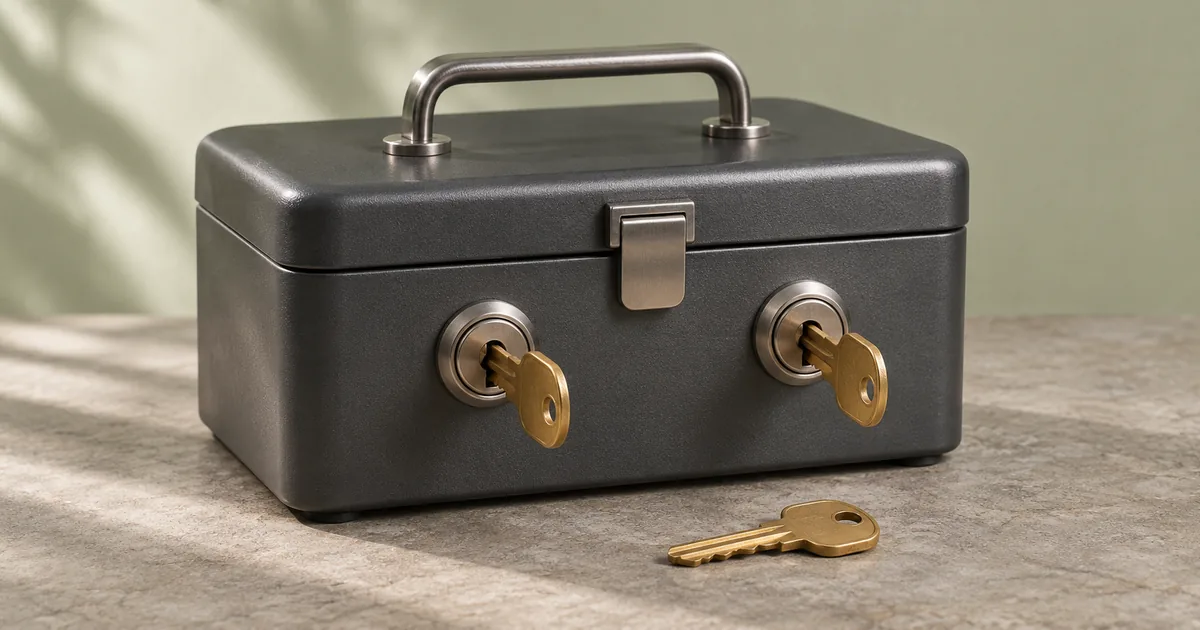
A multisig (multi-signature) wallet is a crypto wallet that needs approval from more than one key before funds can move. Instead of a single key that decides everything on its own, whether it gets stolen or lost, you set up a group of keys and a rule, for example "two out of three must sign". Think of a vault with two locks: nobody opens it alone.
That changes the risk math, for better and for worse. Below, in plain language: what "M-of-N" means, why 2-of-3 became the most common setup, who uses multisig in practice, the trade-offs, and how Safe (formerly Gnosis Safe), the market reference, works. At the end, an honest section on where Picnic fits in this story.
What is a multisig wallet?
A multisig wallet moves funds only when a minimum number of keys approve the transaction. Each key belongs to a "signer" (or "owner"), which can be a person, a device or an institution.
In a regular wallet, a single private key, usually backed up as a 12- or 24-word seed phrase, is the single point of failure. Whoever steals it takes everything. Whoever loses it loses everything (see what to do if you lose your recovery phrase). A multisig spreads that power across several keys so that no single one is enough.
The feature is not tied to one network. On Bitcoin, multisig is part of the protocol itself. On networks like Ethereum it is implemented with smart contracts, which is where Safe dominates.
How does "M-of-N" work?
A multisig rule has two numbers:
- N is the total number of keys (signers) registered.
- M is how many of them must approve a transaction. In Safe, M is called the threshold.
A "2-of-3" wallet has three keys and requires two signatures. A "3-of-5" has five keys and requires three. The table shows common setups and what they are usually used for:
| Setup | What it means | Typical use |
|---|---|---|
| 1-of-1 | One key, one signature | Regular wallet (not really multisig) |
| 2-of-2 | Both keys must sign | Couples or partners; losing one key locks it |
| 2-of-3 | Two of three keys sign | Individuals, families, small teams |
| 3-of-5 | Three of five keys sign | Company or project treasuries |
| 4-of-7 | Four of seven keys sign | Larger organizations, such as DAOs |
There is no single "right" setup. A high M protects against theft but makes every payment slower and raises the chance of locking funds if keys get lost. A low M is convenient but protects less.
Why is 2-of-3 so popular?
2-of-3 balances two opposite threats. If someone steals one key, they cannot move anything, because the second signature is missing. And if you lose one key, two remain, and they can approve replacing the lost key with a new one.
A concrete example: a person keeps one key on their phone, one on a hardware wallet in a drawer at home and a third with a trusted relative or in a safe. To pay, they use the phone and the hardware wallet. If the phone is stolen, the thief has one of three. If the hardware wallet is destroyed, the phone and the relative can solve it together.
Why can a multisig be safer?
The security comes from removing the single point of failure. In practice, that delivers four things:
- Stealing one key is not enough. An attacker needs to compromise M keys, ideally stored in different places and on different devices.
- Losing one key is not the end. With N greater than M, the group can replace the lost key.
- Shared decisions. In a group (family, partners, team), nobody moves the money alone, which reduces internal mistakes and abuse.
- Transparency. Because the rules are recorded on the network, any signer can check who can approve what.
"Safer" does not mean "failure-proof". Multisig swaps one risk for others, as the next section shows.
Who uses multisig wallets?
- People holding larger amounts. A 2-of-3 with keys in different places is a way to hold meaningful savings without depending on one piece of paper with 12 words.
- Families and couples. Two signatures to move shared savings, with a third key as backup.
- Companies and startups. The treasury requires approval from more than one person, and someone leaving the team does not leave the money tied to them.
- DAOs and on-chain projects. Organizations with no physical office use multisigs so a group, not an individual, controls the treasury.
- Teams running smart contracts. Protocol administrators use multisig to control permissions and upgrades.
What are the risks and trade-offs?
Multisig has a real complexity cost. The points that weigh the most:
Losing too many keys locks the money. In a 2-of-3, losing two keys makes the funds unreachable. In a 2-of-2, losing one is enough. Recovery only exists while M keys are still available.
Coordination takes effort. Every transaction needs several people or devices. For a company that is a useful control; for an urgent payment at night, it is friction.
It usually costs more. Verifying several signatures uses more network resources. On cheaper networks the impact is small; when fees spike, it hurts. Creating the wallet, when it is a contract, also has a cost.
Blind signing is still dangerous. The largest crypto theft on record shows this. In February 2025, about US$1.5 billion was taken from the exchange Bybit, which used a Safe multisig. According to Safe's investigation, the attackers compromised a Safe{Wallet} developer's computer and used that access to disguise a malicious transaction, which the signers approved without noticing. The FBI attributed the attack to North Korean actors (The Hacker News, SecurityWeek). The lesson is not that multisig is useless, but that it only works if every signer verifies what they are signing, preferably through more than one channel.
The contract can have flaws. In a contract-based multisig, security depends on the quality of that code. That is why the market prefers widely used, audited implementations over new contracts.
A compromised quorum is still a quorum. If a scammer convinces M signers, the transaction goes through. Multisig does not protect against well-executed social engineering.
Multisig, MPC and passkeys: what is the difference?
They are different answers to the same problem, "a single key is too fragile":
- Multisig uses several independent keys, and the approval rule is recorded on the network (or in the protocol). Everyone can see there are N owners and that M must sign.
- MPC (multi-party computation) splits one key into shares that never come together. On the network it looks like a regular signature. It is common in custody services and wallets that hide complexity, but the approval rule lives in the provider's software, not on the network.
- A passkey replaces the seed phrase with your device's biometrics. It is not a multi-signature scheme, but a way to sign with a key protected by your phone. See the guide on wallets without a seed phrase (in Portuguese).
They can be combined: an account can have a passkey as one of the owners of a multisig, which is one reason Safe is so flexible.
How does a multisig work in practice with Safe?
Safe is the best-known multisig platform in the Ethereum ecosystem. According to Safe itself, the project started in 2017 as a multisig contract built to hold the proceeds of Gnosis's token sale, became the Gnosis Safe product in 2018 and was renamed simply Safe in 2022 (history of Safe). On its official site, checked on November 11, 2026, Safe states that it secures more than US$60 billion in assets, has more than 18 independent smart account audits and runs on more than 40 networks. These are the company's own figures, with no reference date on the site, so treat them as an indication of scale, not as a security guarantee.
A Safe is a smart account: an account that is itself a smart contract (see what is account abstraction, in Portuguese). According to the official documentation, the core concepts are:
- Owners. The list of accounts that can approve transactions. They can be regular wallets, other smart accounts or even passkeys.
- Threshold. The number of approvals required to execute a transaction. It is the "M" in M-of-N.
- Modules. Extensions that add functions without bloating the core contract, such as spending limits, recovery or ERC-4337 compatibility. The documentation treats modules as security-critical pieces that must be audited, and adding or removing one requires approval from the owner threshold.
- Guards. Extra checks that run before and after each transaction. The documentation warns that a faulty or malicious guard can block transactions or lock funds.
A typical transaction flow looks like this:
- One owner proposes the transaction (send an amount, swap an owner, change the threshold).
- The other owners review the details and sign.
- Once the signatures reach the threshold, anyone can execute the transaction on the network.
Changes to the rules themselves (adding or removing an owner, changing the threshold) are transactions like any other and also need the current number of approvals. That is why Safe is flexible: you can replace a lost key without creating a new wallet.
Is a Picnic account a multisig?
Technically, yes, in the simplest form possible: a 1-of-1 multisig. And it is worth being direct about what that means.
Picnic is self-custody software, not an exchange or a broker (see is Picnic a crypto exchange?), and it does not hold users' private keys. Under the hood, each account is a smart account on the Safe standard, run with ERC-4337. In accounts that use a passkey (the WebAuthn credential created in the authenticator you choose, such as Apple's or Google's), the passkey signs. It is the same contract base described above, and self-custody works this way: you keep control of your assets without writing down a seed phrase. For the technical layer, see also the ERC-4337 guide (in Portuguese).
In those accounts, the Safe has one owner (your passkey signer) and a threshold of 1, so a single signature is enough to authorize a transaction. For you, that means whoever can use your passkey controls the account, with no second approval. The app does not offer a multi-key setup such as "2-of-3" today. Picnic may expand its security options in the future, with no date or specific feature guaranteed.
There is also a recovery mechanism, which is a different thing. The account has a recovery module with a guardian (the credential linked to your email) that allows replacing your passkey if you lose access. Recovery involves identity verification, access to your registered email and a protection period, currently 7 days on new accounts, with notifications during that time, per the Terms of Use (clause 4.5) and the module configuration. Neither Picnic nor support can shorten that period, and recovery depends on the account's configuration, the network and access to the required factors. It exists to recover access, not to require a second approval on each payment.
In practice, this means:
- Day-to-day protection depends on your passkey and your phone's lock. Picnic does not receive your biometrics or the private key, but whoever can unlock the device and use the passkey can authorize transactions.
- Losing the passkey without being able to use recovery can mean losing access to the assets, and Picnic does not guarantee reversal of confirmed transactions.
- If you need approval from several people for a company or family treasury, today, while the app account has a single key, that means setting up a multisig yourself, for example with Safe, outside Picnic.
Is multisig worth it for you?
It usually makes sense when there is high value, more than one person involved or a need to separate roles (who proposes, who approves). For small balances and daily use, the complexity and friction rarely pay off, and a passkey wallet or a well-stored hardware wallet does the job with less effort.
If you decide to set one up, a few habits reduce the most common mistakes:
- Spread the keys across different devices, places and people. Two keys on the same phone are not two keys.
- Test with a small amount before depositing your savings, including the process of replacing an owner.
- Write down a recovery plan for whoever would need to act if you were unavailable.
- Check every transaction before signing: destination address, amount and network, preferably through a second channel.
- Use audited, widely used contracts, and only enable modules you understand.
Frequently asked questions
What is a multisig wallet, in one sentence?
It is a wallet where a transaction only happens if a minimum number of keys (for example, two of three) approve it, instead of relying on a single key.
Is multisig the same as multi-signature?
Yes. "Multisig" is short for multi-signature. You will also see it written "multi-sig" with a hyphen.
What does 2-of-3 mean in multisig?
It means three keys are registered and two of them must sign each transaction. Losing one key does not lock the money, and a single stolen key cannot move it.
Are Safe and Gnosis Safe the same thing?
Yes. The platform was called Gnosis Safe and became Safe in 2022, when it separated from Gnosis, according to the history published by Safe itself.
Is a multisig wallet 100% safe?
No. It reduces the risk of a single key, but it is still exposed to contract bugs, social engineering against signers and signatures approved without checking the content. No wallet model removes risk.
What happens if I lose one key in a 2-of-3 multisig?
The two remaining owners can approve replacing the lost key with a new one. If you lose two keys, the funds become unreachable.
Is a Picnic account a multisig?
Technically, it is the simplest version: a 1-of-1 multisig. In accounts with a passkey, the account is a Safe with a single owner (the passkey) and a threshold of 1 approval, so one signature is enough to authorize a transaction. Guardian recovery exists to regain access, not to require multiple approvals per transaction. Picnic may expand its security options in the future, with no date or specific feature guaranteed.
Do I need multisig to have self-custody?
No. Self-custody means you control the keys, whether with a simple wallet, a passkey, a hardware wallet or a multisig. Multisig is one way to do it, mainly suited to high amounts or several people.
Conclusion
A multisig wallet trades the fragility of a single key for a group rule: M-of-N signatures to move funds. 2-of-3 is the most common balance between theft and loss. In exchange, it takes more coordination, costs more and still depends on people paying attention to what they sign, as the 2025 Bybit case made clear.
Safe is the reference for anyone who wants to set one up, with well-documented owners, threshold and modules. Picnic uses, in accounts with a passkey, a Safe configured as a 1-of-1 multisig, with one owner (the passkey), which delivers self-custody without a seed phrase, but with a single signature enough to move funds. Knowing the difference between 1-of-1 and 2-of-3 helps you pick the right tool for each amount. To see how a Picnic account works, visit Picnic.
Picnic is a technology platform that lets users independently interact with USDC, a U.S. dollar-pegged stablecoin issued by Circle, on public blockchains. USDC is not legal tender in Brazil.
Displayed exchange rates vary with market conditions. The final applicable amount is the one shown on the transaction confirmation screen. Cryptoassets involve risks, including volatility and loss of peg.
Picnic does not custody user assets and is neither a financial institution nor a virtual asset service provider. Sending and receiving U.S. dollar payments through a U.S. account is offered in partnership with Noah Savings Inc. Terms and conditions apply.
Information verified in November 2026.

Picnic team
Technology platform
The Picnic team creates content about international finance, cards and digital dollars.
Get your Picnic card
No annual fee, no IOF and no Picnic fee. Open your account in five minutes.
Open your account →