
Tipping in the US: How Much to Give and How to Pay (2026)
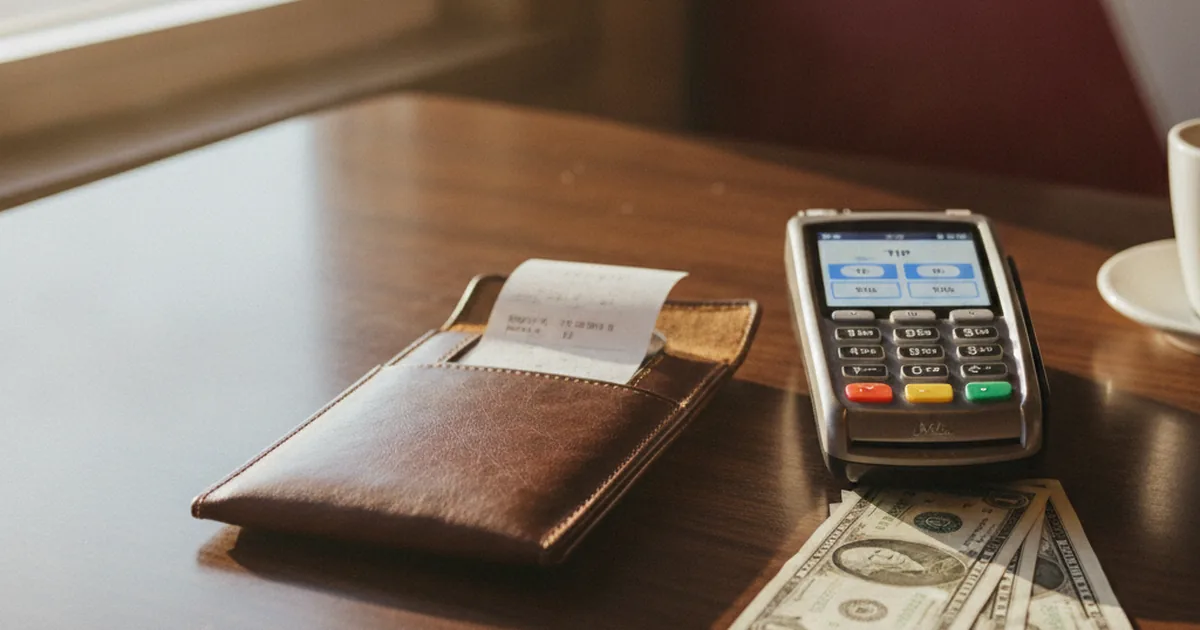
You finish dinner in the United States, the payment terminal arrives and the screen asks: 18%, 20% or 25%? For someone coming from Brazil, where many restaurants add an optional service percentage to the bill, that moment can be confusing. How much should you give? Is it mandatory? Does paying by card add a cost? Tipping in the US is something to budget for when eating out, taking taxis and staying in hotels, not a detail to discover after spending your travel allowance.
This guide answers two practical questions: how much to tip in different situations and how to pay without overlooking payment charges. One point Brazilian travelers can miss is that a tip added to a card is part of their foreign-currency spending. Depending on the card, it can carry IOF and an exchange markup just like the meal. The guidance below was checked on November 11, 2026; tipping ranges are customs, not nationwide legal rates.
Why tipping is strongly expected in the US
In US table-service restaurants, a tip is commonly part of the worker's expected earnings rather than simply a bonus for exceptional service. Under the US Department of Labor's tipped-worker rules, some employers may count qualifying tips toward their minimum-wage obligation, subject to legal requirements. Employers must make up a shortfall, and state or local rules can require higher direct wages. It would be inaccurate to say every server receives the same low base wage or that the customer is legally responsible for paying it.
The social expectation is nevertheless strong. For good table service, budgeting around 18–20% is a practical choice, with 20% a straightforward reference. That is different from saying a voluntary tip is legally compulsory or that 18% is a universal minimum. If service is poor, raise the issue with management rather than assuming every payment-screen suggestion is a rule.
How much to tip in the US by situation in 2026
The amount depends on the service. This practical table draws on the Emily Post Institute's tipping guidance, with restaurant budgeting toward the upper end of its 15–20% range for good service:
| Situation | Practical reference |
|---|---|
| Full-service restaurant | 15–20% before tax; budgeting 18–20% is sensible for good service |
| Fast-casual or counter order | Optional; a screen does not create an obligation. Consider a tip for extra service |
| Bar | US$1–2 per drink, or 15–20% of the tab |
| Taxi | 15–20% of the fare |
| Uber or Lyft | Optional; if you choose to tip, 15–20% is a planning reference, not a platform requirement |
| Food delivery | Around 10–15%; for pizza delivery, Emily Post suggests US$2–5 depending on the order and difficulty |
| Hotel housekeeping | US$2–5 per day, left daily |
| Bellhop | US$2 for the first bag, US$1 for each additional bag |
| Valet | US$2–5 when the car is returned |
Two things stand out. First, restaurant customs are not a fixed national tariff: a terminal offering 18%, 20% and 25% is not proof that 15% has become unacceptable everywhere. Second, not every tip is a percentage. Bars, hotels and valet services often use fixed amounts per drink, day or bag, which is where a little cash can be useful.
For ride-hailing specifically, Uber confirms that tipping is optional. You can select a custom amount rather than treating the app's presets as mandatory.
What amount should you use: before or after tax?
This is a common source of confusion. A US restaurant bill adds sales tax, which varies with state and local rules and is separate from a tip. A conventional etiquette reference is to calculate the tip on the subtotal before tax, not the tax-inclusive total. The tax goes to the government, not the person who served you.
The difference may be small on a modest bill, and some people use the final total for convenience or generosity. You do not need to argue over a tiny difference. If you want a consistent method throughout your trip, use the pretax subtotal and check what base the payment terminal uses for its suggested percentages.
Another detail matters for groups: some restaurants include an automatic gratuity or service charge. Check before adding more. A compulsory service charge is legally different from a voluntary tip, and its distribution can differ; ask whether it covers gratuity rather than assuming every fee reaches your server or always adding another 20% on top.
How to pay a tip by card in the US
In many full-service restaurants, you can add the tip to the same card payment. Two common formats are:
- A paper slip. The server brings a receipt with “Tip” and “Total” lines. You write the tip, add the total and sign. The final charge including the tip is processed afterward.
- A terminal or tablet. The screen displays preset percentages and usually a custom amount option. Select a suggestion or enter your own amount.
In these restaurant flows, the tip normally forms part of the dollar transaction for the meal. For your card, it is foreign spending like the rest of the bill. Other services, including apps, may process a tip separately, so check the receipt rather than expecting every tip to appear in one identical format.
Also distinguish authorization from the final charge. Visa explains that a restaurant card authorization can occur before the tip is applied, so an initial app notification may differ from the amount that finally posts. Keep your signed receipt, leave enough available balance for the intended total and check the completed transaction. A temporary hold is not automatically a duplicate settled charge, and there is no universal guaranteed release or refund time for every restaurant and card.
Where a card tip is unavailable, cash remains useful. Keep a small supply of US$1 and US$5 notes for hotel staff, valet parking or a bar. If obtaining those notes requires an ATM, consider fixed withdrawal charges before making several small withdrawals. Our guide to when overseas ATM withdrawals make sense covers that trade-off.
DCC: be careful with “charge me in reais”
A terminal, or a website when booking services, may ask whether you want to pay in your home currency, Brazilian reais, rather than dollars. Showing a converted total can feel helpful, but the conversion comes at a price.
This is dynamic currency conversion, or DCC. Visa requires disclosure of both currencies, the exchange rate and additional charges, plus a choice to accept or decline. There is no reliable universal percentage by which every DCC offer is worse, so compare the actual offer rather than trusting an unsourced “6–10%” rule. A practical default is to choose without conversion or local currency, USD, letting your card's terms govern any necessary conversion. The guide to paying in reais or local currency explains the choice in more detail.
A card tip can also carry IOF and an exchange markup
Because a dollar tip is foreign-currency spending, it can incur the same costs as the meal. On the relevant traditional Brazilian international-card exchange transaction, IOF is 3.5% under Decree 12,499/2025. The issuer's exchange markup is a separate charge and varies by institution; do not assume every bank uses 4%. Our article on what IOF is and why it matters gives more background. Confirm the tax and fee treatment of your particular card before traveling.
Consider a US$120 restaurant subtotal with a 20% tip:
- Tip: US$24.
- Hypothetical Brazilian credit card: with a 4% exchange markup, the dollar-equivalent base becomes US$24.96. Adding 3.5% IOF on that base produces about US$25.83, or US$1.83 extra on the tip. This is an illustration; the actual reais conversion and issuer calculation govern the bill.
- Existing Picnic card, spending in USD: the US$24 tip uses US$24 of card balance, with no IOF or Picnic spending markup. Obtaining that balance is a separate step that may cost money.
The difference can accumulate. If, purely as a budget example, a ten-day trip includes US$60 a day in combined restaurant, bar, taxi and delivery tips, that is US$600. Under the hypothetical compounded charges above, the additional cost is approximately US$45.84. Your real spending can be much lower or higher; this is not a forecast or guaranteed saving.
Picnic's current fee treatment is specific to its digital-dollar product and should not be generalized to every international card. The published Picnic fee schedule lists zero IOF and no additional charge on USD card purchases, but a 0.3–0.5% provider cost on Pix card top-ups. The quote is shown before confirmation. Zero spending fees do not mean a zero-cost journey from reais to dollars, and tax treatment can change.
Tip creep: when choosing zero is reasonable
You will see tip prompts beyond traditional table service: a coffee collected at the counter, a convenience store or a self-service kiosk. Often called tip creep, this is the spread of gratuity requests into more checkout situations.
At a counter, a tip is generally optional. Choosing “no tip” does not automatically make you rude. Consider the service actually provided and any extra assistance rather than letting a screen set the rule. This does not erase the established tipping custom at full-service restaurants; it distinguishes that custom from every touchscreen asking for more money.
When you still need cash
Even if you pay for most things by card, some tips are easier, or only possible at that location, in cash:
- Hotel housekeeping: US$2–5 per day, left daily because the person cleaning may change. A note marked “Housekeeping, thank you” makes your intention clear.
- Valet and bellhop: small notes let you tip when the car is returned or the bags are delivered. Some businesses also offer digital options, so ask if needed.
- A busy bar: if the bartender charges only for the drinks, cash lets you leave the tip separately; US$1–2 per drink is a common reference.
Have some small notes from the start. Avoid withdrawing a large amount just “to be safe,” but do not assume every US business accepts contactless cards either. Use a card where accepted and keep cash for the gaps, accounting for any ATM operator and card fees when obtaining it.
Where Picnic fits
The Picnic Visa card uses a digital-dollar balance and has no annual fee, IOF or Picnic markup on USD card spending. In the US, a restaurant tip charged in dollars therefore does not add a separate Picnic currency-conversion charge. That is a claim about spending the existing dollar balance, not about getting dollars from reais: Pix card funding currently includes the provider cost described above.
Availability matters for travel planning. New Picnic card orders have been paused since September 22, 2026, and existing cards remain usable until December 20, 2026, at 23:59 UTC. Do not plan around immediate issuance or use beyond that date.
For existing cardholders traveling within that window, the 18%, 20% or custom tip choice can remain about the service rather than a Picnic spending surcharge. Apple Pay and Google Pay are supported where the merchant accepts the relevant payment method; our guide to cards for the US covers everyday travel use. If your itinerary includes theme parks, the same budgeting logic applies to meals and tips in the Disney spending guide.
The point is not to avoid tipping. It is to separate what you choose to give the worker from what your payment method charges for making the payment.
In short
Treat customary tips as part of your US travel budget, without confusing voluntary tipping with a compulsory service charge. For table service, 15–20% before tax is an established reference, and budgeting 18–20% for good service is practical. Bars often use US$1–2 per drink; taxis, 15–20%; hotels and valet services use smaller fixed amounts. Ride-hailing tips remain optional.
You can usually add restaurant tips by card using a slip or terminal. Keep small notes for situations where that is inconvenient or unavailable, check for included gratuity and review final charges rather than just authorization alerts. Avoid accepting DCC without comparing its rate, and remember that your card's IOF and exchange costs can apply to tips too.
Before traveling, decide how much cash you need for small tips and compare the full cost of your remaining payment options. With Picnic, existing cardholders should distinguish zero USD spending fees from funding costs and keep the current card-use deadline in mind. The tip itself should remain a clear choice about the service you received.
Picnic is a technology platform that lets users independently interact with USDC, a U.S. dollar-pegged stablecoin issued by Circle, on public blockchains. USDC is not legal tender in Brazil.
Displayed exchange rates vary with market conditions. The final applicable amount is the one shown on the transaction confirmation screen. Cryptoassets involve risks, including volatility and loss of peg.
Picnic does not custody user assets and is neither a financial institution nor a virtual asset service provider. Sending and receiving U.S. dollar payments through a U.S. account is offered in partnership with Noah Savings Inc. Terms and conditions apply.
Information verified in November 2026.

Picnic team
Technology platform
The Picnic team creates content about international finance, cards and digital dollars.
Get your Picnic card
No annual fee, no IOF and no Picnic fee. Open your account in five minutes.
Open your account →