
Morocco: Is It Better to Bring a Card or Cash?
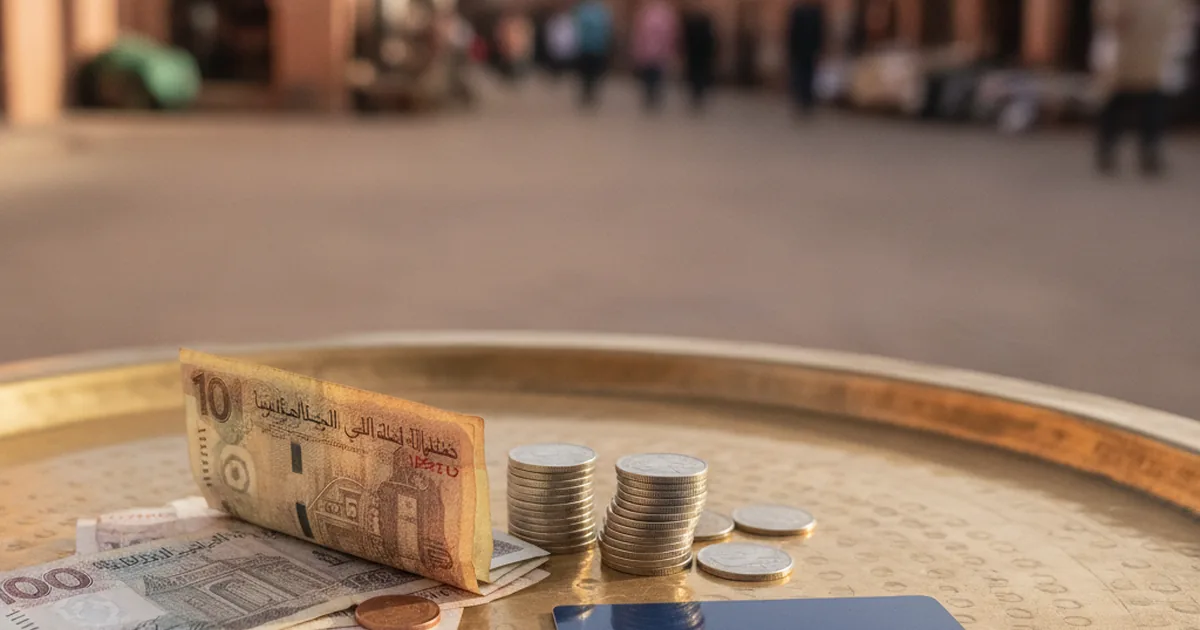
In Morocco, relying on your card alone is an efficient way to be unable to pay at exactly the café, taxi or stall you were looking for. Carrying only cash isn't the best answer either: it raises the risk of loss and forces you to settle your whole budget before the trip.
The practical answer to "Morocco: card or cash?" is bring both. Use your card at hotels, established restaurants, shops and for larger expenses. Keep some Moroccan dirhams for medinas, markets, taxis, tips and small businesses. That way you carry less cash without depending on whether every place has a working card terminal.
This guide shows how to set up that combination, get dirhams once you arrive and recognize a bad conversion. Rules and fees were checked as of November 2026 and may change. The terminal or ATM screen shows the local charges presented at that moment, but the total cost also depends on your card's terms.
Quick answer: bring a card and a dirham reserve
The best setup isn't splitting your budget into equal parts. It's giving each payment method a job:
- Main card: hotel, transport tickets, larger restaurants, shops, supermarkets and bigger purchases where the card network is accepted.
- Dirhams in cash: taxis, souks, stalls, small cafés, tips, restrooms and local businesses without a terminal.
- Second card: a backup in case of a failure, a block or a terminal that won't take your card.
- Small reserve in euros or US dollars: a plan B to exchange at an authorized operator if your cards fail. It is not your everyday payment currency.
This strategy keeps you flexible. You don't need to carry your whole budget in notes, but you're also not betting that every business in Fez, Marrakech or a smaller town will take cards.
What is Morocco's currency?
The official currency is the Moroccan dirham, written as MAD or DH. Morocco's official tourism board says there are 20, 50, 100 and 200 dirham notes, plus smaller coins.
That settles a common question: euros and dollars can be useful for exchanging, but they don't replace the dirham as the local currency. Even when someone accepts euros, the seller sets the conversion and your change may come back in dirhams. Without comparing the rate, you don't know how much you really paid.
There's also an important border rule. The Office des Changes, Morocco's foreign exchange authority, states that travelers may bring in or take out at most MAD 2,000 in banknotes. In practice, most of your local cash should be obtained inside the country, and it's best to avoid ending the trip with a large dirham balance.
Where do cards work in Morocco?
According to Morocco's official travel formalities page, international Visa and Mastercard cards are accepted by most hotels and by some restaurants, shops and petrol stations. The wording matters: "most hotels" does not mean "every business".
In tourist cities, acceptance tends to follow the type of establishment. A chain hotel, an established restaurant, a mall or a brand-name store is more likely to accept cards. A small riad, a souk vendor, a neighborhood café or a driver may work only in cash.
Use this matrix as a starting point, not a guarantee:
| Situation | Most practical method | Plan B |
|---|---|---|
| Hotel or riad | card, if confirmed when booking | dirhams or another card |
| Established restaurant | card | dirhams |
| Souk and small shop | dirhams | ask before buying |
| Taxi | dirhams | agree on price and payment before the ride |
| Supermarket or mall | card | dirhams |
| Tour or activity | depends on the operator | confirm in advance and bring dirhams |
| Tips and small expenses | dirhams, ideally in smaller notes | set aside change in advance |
Before you order or buy, ask whether the terminal is working. A card-network sticker on the door doesn't guarantee the machine is online at that moment.
How to get dirhams: ATM or exchange office?
You have two main routes to get cash in Morocco. The better one depends on the fees shown at the time and the card you use.
Withdrawing from an ATM
According to the official tourism board, ATMs are widespread throughout the country. Withdrawing is convenient because you avoid carrying a large sum in foreign currency and can top up your cash gradually.
The cost, however, can have more than one layer:
- a fee charged by the Moroccan ATM;
- your card issuer's international withdrawal fee;
- the currency conversion;
- possible DCC, if you agree to be charged in another currency.
There is no universal fee that applies to every machine and every card. Read the screen all the way through. If the ATM shows a fee before you confirm, compare that fixed cost with the amount you're withdrawing. Several small withdrawals tend to repeat a fee that could have been charged only once, but an overly large withdrawal creates unnecessary risk.
Read the complete guide to withdrawing from ATMs abroad (in Portuguese) before you travel, and prefer bank-operated machines in busy places during branch opening hours.
Exchanging euros or dollars for dirhams
The Office des Changes authorizes banks, currency exchange operators and approved sub-delegated establishments to carry out manual currency exchange. The official tourism board mentions counters at airports, hotels, banks and exchange offices in the cities. Bring your passport, because the counters require it for the transaction.
This route can make sense if you already have euros or dollars, or want a backup that doesn't depend on your cards. Compare how much you receive in MAD, not just the phrase "no commission". A zero fee with a bad rate is still an expensive exchange. Keep the receipt and exchange only what you expect to use.
The airport solves your arrival, but it doesn't need to fund the whole trip. If you need cash for transport and a first meal, exchange a small amount and compare other options in the city. The article on exchanging money at the airport (in Portuguese) shows where the cost usually hides.
At the card terminal and the ATM, always choose MAD
When you pay or withdraw, the terminal may offer to charge you in dirhams or to convert the amount into dollars, euros or even Brazilian reais. That second option is dynamic currency conversion, known as DCC.
Visa explains that the offer must show the amounts in both currencies, the exchange rate used and any additional fees or markup. The merchant or ATM must leave the decision to you and must not choose on your behalf.
The operating rule is simple: choose MAD and decline the terminal's conversion. That way the conversion is handled by the card network and your card issuer, whose cost you can know in advance. If you accept dollars, euros or reais, you hand the rate over to whoever operates that machine.
On screen, look for options such as "continue without conversion", "decline conversion" or the charge in MAD. If the attendant selects another currency without asking, ask them to cancel and redo it. The guide on paying in reais or in the local currency (in Portuguese) explains the mechanism in more detail.
How much cash should you bring to Morocco?
There is no universal daily amount. A trip with hotels and tours already paid needs far less cash than a route through smaller towns, with local transport and meals at small establishments.
Instead of copying an average from the internet, plan for 24 to 48 hours at a time:
- List the expenses that probably won't accept cards: local transport, small meals, tips and market purchases.
- Add a margin for the unexpected, without turning that margin into your whole budget.
- Keep the rest accessible on your card.
- Top up your cash as you go, after comparing ATM withdrawals and exchange.
If your hotel and tours are already paid, the reserve may only need to cover local expenses at the start of the trip. If you're heading to the desert or remote areas, increase your cash before leaving the city. The right question isn't "how many dirhams a day does every traveler use?" but "which expenses on my next leg require cash?".
See also the method for deciding how much money to bring on an international trip, without relying on a single exchange rate.
What does it cost a Brazilian to pay in Morocco?
The card cost depends on the issuer. On a conventional Brazilian international card, Decree No. 12,499/2025 sets 3.5% IOF (Brazil's tax on financial operations) on international purchases and withdrawals. On top of the tax, the issuer may apply an exchange-rate spread (in Portuguese) and a withdrawal fee.
Card availability: new Picnic card orders have been temporarily paused since September 22, 2026 (notice in Portuguese), with no confirmed date for reopening. Existing cards keep working normally until December 20, 2026, at 23:59 UTC; after that, cardholders continue on Gnosis Pay's new infrastructure through an upgrade in the app, which starts with the virtual card (the physical card has no confirmed date yet). The conditions below apply to people who already have the card.
With the Picnic card, purchases in MAD carry 0% IOF and zero Picnic margin. Because the card balance is in digital dollars, a purchase in dirhams goes through Visa's conversion, which costs about 0.3%, according to Picnic's fee table. Loading the balance via Pix, Brazil's instant payment system, also has no Picnic fee and no IOF, but the quote includes a provider cost of 0.3% to 0.5% compared with the market rate (as of November 2026). So it would be wrong to call spending in MAD a zero total cost.
On a purchase equivalent to R$ 1,000, the difference starts with the tax: a conventional card may add R$ 35 in IOF before the issuer's spread; with Picnic, there is no IOF. The final amount still depends on each option's exchange rate, and the app shows the cost of converting reais to load your Picnic balance before you confirm.
The benefit applies to purchases; it doesn't remove a possible fee from the Moroccan ATM. If your priority is getting cash, compare the total cost of the withdrawal. If the business accepts cards, paying directly usually skips a step and reduces the need to carry notes.
Picnic is a technology platform with an international account and a Visa card. The card has no annual fee, works wherever Visa is accepted and can be added to Apple Pay and Google Pay. Check current conditions and card availability in the app.
A practical payment plan for the trip
Before you fly
- Bring two cards, kept in different places.
- Check your PIN, limits, international withdrawals and your issuer's support.
- Avoid buying a large amount of dirhams before the trip; the official rule limits carrying local currency across the border to MAD 2,000.
- If you want a backup, bring a small reserve of euros or dollars in good condition.
- Budget by category, separating what's already paid from what you'll pay at the destination.
When you arrive
- Get only the dirhams you need for transport and first expenses.
- Check the fee, rate and currency before confirming a withdrawal or exchange.
- Set aside smaller notes for taxis, tips and small expenses.
- Don't accept help from strangers at the ATM and never hand your card to anyone else.
During the trip
- Ask how you can pay before you order or start a ride.
- Pay for larger purchases by card when there's a reliable terminal.
- Always choose MAD on the terminal.
- Top up your cash leg by leg, especially before leaving urban centers.
- Track your transactions in the app and freeze your card immediately if you spot anything you don't recognize.
So, card or cash in Morocco?
Card as your main method and dirhams as a complement is a practical combination, adjusted to how widely cards are accepted along your route. The card reduces how much cash you carry, makes spending easier to track and tends to work at larger establishments. Cash keeps your trip moving in places where there is no terminal or it isn't available.
Three rules cover almost everything: don't count on universal acceptance, always choose MAD and get cash a little at a time. Add a second card and a small reserve in a strong currency, and a single failure won't become a problem for the whole trip.
If you already have the Picnic international card, it can lower the cost of your purchases in dirhams: 0% IOF, zero Picnic margin and no annual fee. When you convert reais to load your balance, the app shows the cost before you confirm; for purchases in MAD, factor in Visa's conversion separately. If you don't have the card yet, check current card availability (notice in Portuguese) before you plan around it.
Picnic is a technology platform that lets users independently interact with USDC, a U.S. dollar-pegged stablecoin issued by Circle, on public blockchains. USDC is not legal tender in Brazil.
Displayed exchange rates vary with market conditions. The final applicable amount is the one shown on the transaction confirmation screen. Cryptoassets involve risks, including volatility and loss of peg.
Picnic does not custody user assets and is neither a financial institution nor a virtual asset service provider. Sending and receiving U.S. dollar payments through a U.S. account is offered in partnership with Noah Savings Inc. Terms and conditions apply.
Information verified in November 2026.

Picnic team
Technology platform
The Picnic team creates content about international finance, cards and digital dollars.
Get your Picnic card
No annual fee, no IOF and no Picnic fee. Open your account in five minutes.
Open your account →