
How to Avoid IOF on International Subscriptions [2026]
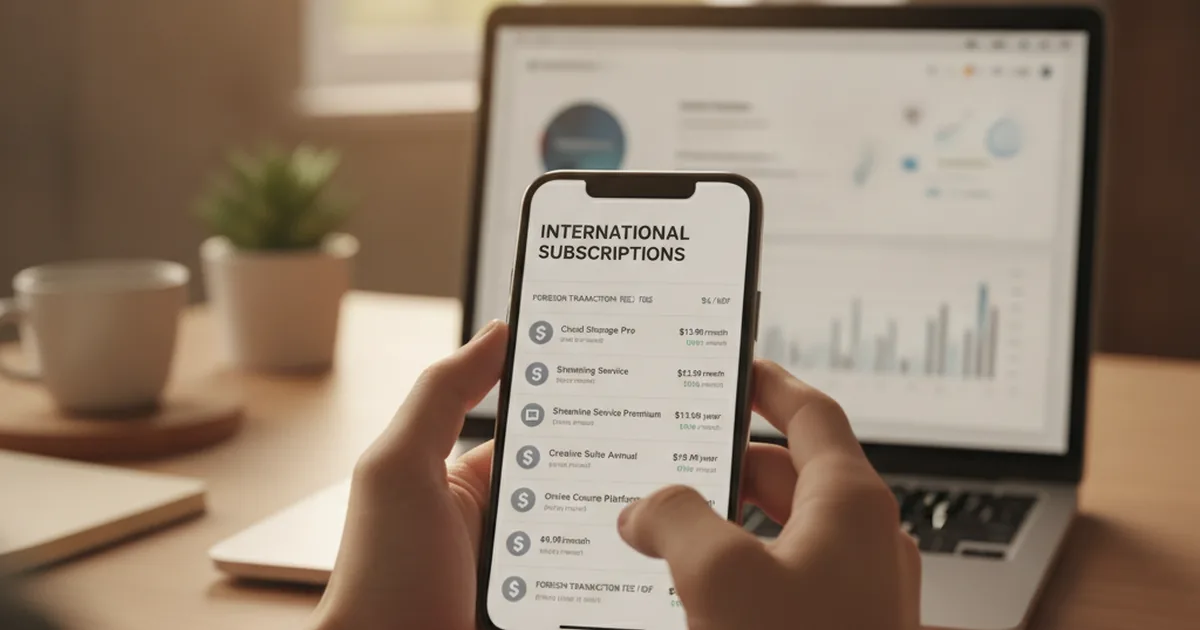
Most "international" subscriptions you're afraid of paying IOF (Brazil's financial operations tax) on actually don't charge anything. Netflix, Spotify, and Disney+ are billed in reais (BRL) in Brazil, so the foreign exchange IOF simply doesn't apply. The problem lies with the others: ChatGPT, AI tools, editing software, and cloud services that charge in dollars every month, almost always without you noticing.
The confusion happens because almost no one knows what the real trigger for the IOF is. It's not the company's nationality. It's the currency in which the charge is processed. A subscription from an American company billed in reais doesn't pay IOF. A charge in dollars, even a small one, does. This detail also appears in the difference between commercial and tourist dollar: what defines the cost is the foreign exchange operation itself, not who is on the other side.
This guide shows you how to find out in one minute which of your subscriptions are billed in dollars, how much the 3.5% IOF plus the spread are taking out of your pocket every year, and the three ways to eliminate this fee. With real numbers and official sources, verified in July 2026.
What really triggers the IOF on a subscription
The IOF on foreign exchange operations applies when there is a conversion from reais to a foreign currency. On a card, this happens the moment the invoice is processed in dollars (or euros, pounds, etc.) and your bank converts the amount to reais.
The current rate is 3.5% on foreign currency purchases and subscriptions made with a credit, debit, or prepaid card by residents in Brazil. It has been valid since June 2025 and was confirmed by the Supreme Federal Court in July of that year. Decree No. 12,499/2025 revoked the schedule that planned the gradual reduction of the IOF until its exemption in 2028. In other words: don't expect automatic relief; the 3.5% is here indefinitely.
On top of the IOF, there is also your card's spread, the margin the issuer adds to the dollar exchange rate at the time of conversion. Depending on the bank, this spread is between 2% and 5%. Adding IOF plus spread, a dollar charge on a traditional credit card carries close to 6% to 8% in hidden costs. If you want to understand the mechanics behind this charge, it's worth reading what IOF is and how the exchange spread works in detail.
The practical conclusion is simple: what matters is not where the subscription comes from, but in what currency it lands on your credit card bill.
Netflix, Spotify, and Disney+: why they don't pay IOF
Here is the part that saves your energy. The most popular streaming subscriptions operate with local billing in Brazil. When your account is Brazilian, Netflix, Spotify, Disney+, YouTube Premium, and Amazon Prime Video charge in reais, with a fixed BRL amount every month.
Since there is no currency conversion, there is no foreign exchange operation. And without foreign exchange, there is no IOF or spread. The price that appears in the app is exactly what hits your bill.
The easiest proof to see this: Netflix and Spotify gift cards bought in reais only work on accounts billed in reais and are rejected on accounts set up in dollars. It's the platform itself confirming that your Brazilian account runs in the local currency.
So, if your concern was the "streaming IOF," you can relax. For these subscriptions, there is no IOF to save on, and any content that says otherwise is wrong. The money slipping away is somewhere else.
The subscriptions that actually leak IOF
The IOF appears on subscriptions billed directly in dollars, which are usually the very tools you use for work or study. The most common among Brazilians:
- Artificial intelligence and productivity: ChatGPT Plus ($20/month when billed in dollars), Midjourney, Notion on paid plans, Figma.
- Software and editing: some Adobe plans and video editors billed outside Brazil.
- Cloud and SaaS: AWS, Google Cloud, Shopify, Webflow, and most hosting and automation tools.
- Creators and games: Patreon (in dollars) and Steam, when you buy games without selecting payment in reais.
For these, the charge arrives in dollars, your bank converts it to reais, and charges 3.5% IOF plus the spread. Individually, it seems like little: on a $20 subscription, the IOF alone is about $0.70 per month. The problem is that these charges are recurring and accumulate month after month, on autopilot, without ever being highlighted.
How to find out in one minute if your subscription is billed in dollars
You don't have to guess. There are two quick ways to know:
- Look at your card statement. Foreign currency charges appear with the original dollar amount next to the converted amount in reais, and often with a separate "IOF" line right below. If the line shows only a fixed and identical BRL amount every month, it's a charge in reais, with no IOF.
- Check the currency on the receipt or the subscription dashboard. On the service itself, the payment page shows whether the price is in USD or BRL. A price in USD means conversion, IOF, and spread on your bill.
A tip: the value in reais of a subscription billed in dollars changes slightly every month, following the exchange rate. If you notice that the same service comes to R$102 one month and R$106 the next, it's a clear sign that the charge is in dollars.
The three ways to stop paying IOF on dollar subscriptions
After identifying which subscriptions land in dollars, there are three paths to eliminate or reduce the IOF. They are not mutually exclusive.
1. Change the billing currency to reais, when the service allows it
Some services already offer local billing in reais. ChatGPT, for example, started offering plans billed in BRL in Brazil, and Steam allows you to choose payment in reais in your wallet. By migrating the billing to reais, you eliminate the conversion and, with it, the IOF and the spread. It's worth checking the settings of each subscription to see if this option exists.
2. Pay with a dollar card
For services that only charge in dollars, the solution is to pay with a balance that is already in dollars, without going through the bank's conversion. This is where the cost plummets: if the dollar charge is debited from a dollar balance, there is no foreign exchange operation at the time of payment and, therefore, no IOF or spread.
This is exactly what Picnic's international Visa card with no annual fee allows. Since the balance is kept in digital dollars, a $20 subscription on ChatGPT is debited as $20, period. Spending in dollars on Picnic has zero cost: 0% IOF and 0% spread (Picnic even absorbs the 1% fee that the Visa network charges issuers). For purchases in currencies other than the dollar, the cost is about 0.3%, just the margin of the Visa network itself.
3. Consolidate and prefer the annual plan
Many services give a 15% to 20% discount on the annual plan. Besides reducing the base price, this means a single dollar charge per year instead of twelve, which decreases the frequency with which the IOF and spread apply. It's a minor optimization, but it adds up in the end.
How much this adds up to in a year
A concrete example to measure the leak. Imagine you pay, in dollars, for a common set of tools: ChatGPT Plus ($20), an AI image tool ($10), Notion ($10), and a Patreon pledge ($10). That's $50 a month billed in dollars.
On a traditional credit card, with 3.5% IOF plus a 4% spread, this set carries about 7.5% in extra costs. That's approximately $3.75 per month, or $45 per year just in fees, not counting the value of the subscriptions themselves. At the July 2026 exchange rate (dollar at R$5.40), that's about R$243 per year evaporating in taxes and spread.
By paying for the same subscriptions with a dollar card with no IOF and no spread, this amount stays in your pocket. And the more dollar tools you accumulate, the bigger the leak you cut.
Picnic: how to pay for a dollar subscription without IOF
Recapping the mechanism, because it's the heart of the savings: the IOF only exists when there is a conversion from reais to dollars. If the payment comes from a balance that is already in dollars, this conversion doesn't happen.
On Picnic, you maintain a digital dollar balance and pay for dollar subscriptions directly from it, using the Visa card or by adding the card to Apple Pay and Google Pay for recurring charges. The result is 0% IOF and 0% spread on dollar charges. For the freelancer or company that also needs to pay suppliers and tools abroad, the same logic applies to all recurring software spending.
An organizational tip that helps day-to-day is dedicating a permanent virtual card to each subscription, named after the service. This doesn't change the cost; what defines the IOF and spread is the underlying account, not the card. What changes is control: canceling a stubborn subscription becomes as easy as deleting that card, without disrupting other recurring charges.
It's worth reiterating the honesty that already appears throughout the text: for Netflix, Spotify, and other subscriptions billed in reais, there is no IOF and, therefore, no savings to be made. The advantage of the dollar balance is specific to dollar charges, which are precisely the ones that go unnoticed.
Summary: stop leaking IOF on autopilot
The IOF on international subscriptions is less scary and more silent than it seems. Three rules solve almost all cases:
- The billing currency is what matters, not the company's country. Billing in reais (Netflix, Spotify, Disney+) does not pay IOF. Billing in dollars (ChatGPT, AI tools, SaaS) pays 3.5% plus spread.
- Find out what lands in dollars. Look at your card statement and the dashboard of each subscription. If the BRL amount changes every month, it's a dollar charge.
- Eliminate the IOF where it exists. Switch the billing to reais when possible, and for services that only charge in dollars, pay with a dollar balance to eliminate the conversion.
If your goal is to stop losing a few reais every month to a foreign exchange tax you didn't even know you were paying, Picnic combines a digital dollar balance and a Visa card with no annual fee, no IOF, and no spread on dollar spending. It's the difference between paying $20 and paying $20 plus fees for a subscription that costs the same $20.
Create your Picnic account and pay your dollar subscriptions without IOF.
Picnic is a technology platform that lets users independently interact with USDC, a U.S. dollar-pegged stablecoin issued by Circle, on public blockchains. USDC is not legal tender in Brazil.
Displayed exchange rates vary with market conditions. The final applicable amount is the one shown on the transaction confirmation screen. Cryptoassets involve risks, including volatility and loss of peg.
Picnic does not custody user assets and is neither a financial institution nor a virtual asset service provider. Sending and receiving U.S. dollar payments through a U.S. account is offered in partnership with Noah Savings Inc. Terms and conditions apply.
Information verified in April 2026.

Picnic team
Technology platform
The Picnic team creates content about international finance, cards and digital dollars.
Get your Picnic card
No annual fee, no IOF and no Picnic fee. Open your account in five minutes.
Open your account →