
Acelerando #02: microschools, homeschooling and AI in education, with Jean Hansen
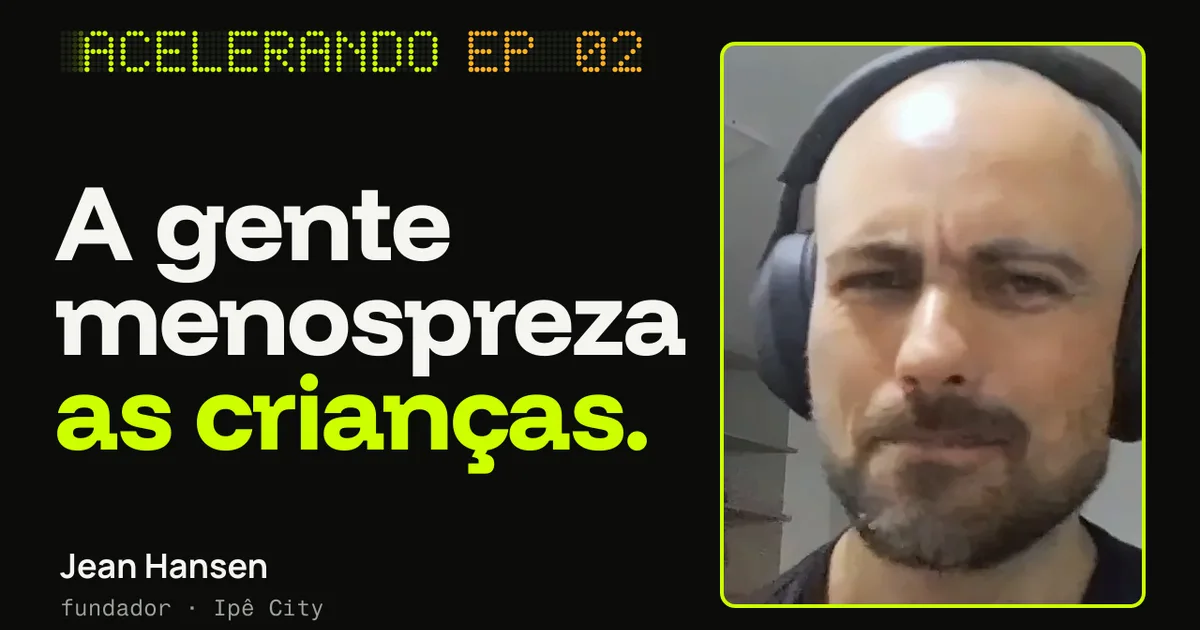
Acelerando is Picnic's podcast of conversations with people who use AI for real at work. In episode 02, João Ferreira, Picnic's co-founder and CEO, talks with Jean Hansen, founder of Ipê City and maker of the documentary series The Network Society. Jean had just spent a month in the United States and Canada visiting schools and projects that are reinventing education. The episode is in Portuguese, with Portuguese subtitles on YouTube.
Where to listen and watch: ▶️ YouTube · 🎧 Spotify (show) · 🎧 Deezer (show)
It is 1h35 on what Jean saw: platforms that adapt content to each child's pace, microschools, families who educate at home and what changes when AI enters the classroom. We also talk about why almost none of this has reached Brazil and what a parent can do right now. Below is a summary that follows the episode's chapters, with the timestamp of each so you can jump straight to it. Quotes are kept in the original Portuguese, with our translation underneath. Numbers and opinions belong to the speakers, and we flag where we did not check them.
Resources mentioned in the episode
Only what was said in the episode and has an official link is listed here.
Tools and products
- Math Academy: a math platform that maps what a child knows and serves the activity at the right level.
- Mentava: an app that teaches young children to read.
- Synthesis: online group games for solving problems, and an AI math tutor.
- Khan Academy: recalled by João as one of the first to individualize teaching, created by Salman Khan.
- Alpha School: a school Jean had heard of before the trip.
- ChatGPT and Claude: used by a child to write and illustrate a book, and suggested by Jean for researching new solutions.
Schools, networks and programs
- Acton Academy, Slope School, KaiPod and Prenda: the four microschool networks Jean covered.
- Thiel Fellowship: a program for young people with a project they are passionate about, mentioned near the end.
- SpaceX: where, according to Jean, the school that led to Synthesis began.
Documentary and Jean's projects
- The Network Society, episode 3: the documentary about the trip.
- Frontier Education Wall: the page with all the projects in the episode.
- Ipê City.
Articles and data
- Saeb 2025, Todos Pela Educação study: 58.6% of public-school 12th graders below the basic level in math (1:11:59). In Portuguese.
- Back to school and young people's mental health in the US (1:12:43): Hansen and Lang (2011), "Back to school blues", Hansen, Sabia and Schaller at NBER and the published version in the Journal of Human Resources (2024).
- Families prosecuted for homeschooling in Brazil (37:03), in Gazeta do Povo and in its report on the Jales case. Both in Portuguese.
If you or someone close to you needs emotional support, the CVV (Brazil) offers free help 24 hours a day at 188 or at cvv.org.br. If you are outside Brazil, look for a local crisis line.
No books with a title were cited in this episode.
Episode chapters
- 0:00 Cold open: four lines from the episode
- 0:32 Opening: the trip through the schools
- 4:15 Each child at their own pace
- 8:21 Inside Math Academy
- 14:01 Why what works does not scale
- 26:16 School choice and the inflection point
- 33:16 Charter schools, microschools and the MEC
- 38:02 We underestimate children
- 43:32 Acton and the Socratic method
- 52:34 Synthesis and school in modules
- 1:00:34 Mentava: reading at 3 and screens
- 1:09:08 The gap in Brazil and how to change it
- 1:21:34 What a parent can do now
- 1:32:20 Closing
Cold open: four lines from the episode
Four excerpts from the conversation set the tone before the intro. Topics include assessing what's wrong with Brazilian education before debating the curriculum, an app that teaches children to read, and the risk of outsourcing your thinking to a chatbot.
Opening: the trip through the schools
João introduces Jean, a friend of several years, and asks for the overview of the trip. Jean says it was made to record the third episode of his series, which follows startups that reinvent institutions. They went through Austin, California, Seattle, Provo (Utah), New York and Toronto and saw three kinds of project: platforms and AI tutors that go straight to families, microschools that combine platforms with physical activities, and traditional schools trying to reinvent themselves.
"a viagem foi para gravar o terceiro episódio da nossa série documental, The Network Society"
(the trip was to record the third episode of our documentary series, The Network Society)
Jean says he saw fifth graders doing calculus and children aged two to four already reading books. That is what he observed during the visits.
Each child at their own pace
João wants to know whether these cases are the exception or the whole class is pulled up. For Jean, one of the biggest brakes of the traditional system is that everyone has to move at the same speed, which hurts both fast and slow learners. Sometimes it is the same child: fast in math, slower in biology or languages.
"é muito comum você ter crianças que conseguem completar um nível, uma série, como a gente chama aqui no Brasil, em três, quatro meses."
(it is very common to have children who finish a level, a grade as we call it in Brazil, in three, four months.)
From what he saw, he estimates that 10% to 30% of the students in the classes he visited move faster than the usual pace. That is an impression from visiting the schools, not a study. He also says it was common for a child doing badly in math at a traditional school to move to an alternative school and become one of the best in the class.
Inside Math Academy
João asks how Math Academy works and whether a family in Brazil could use it. Jean explains it is a paid digital platform, used by schools, homeschooling families and adults. It places a person on a knowledge graph, serves the challenge at the right level, uses light gamification with XP, schedules reviews when the content could be forgotten and mixes topics in a single activity instead of blocks of only fractions.
"eles estão aplicando toda a engenharia que a gente já sabe em aplicativos para consumidor final, por exemplo, redes sociais"
(they are applying all the engineering we already know from consumer apps, for example social networks)
According to Jean, two to two and a half hours a day is enough to cover the content, and someone who commits does two or three grades in one year. That is his claim; we did not check it.
Why what works does not scale
João says he worked on A/B tests, the controlled experiments of tech companies, and finds it odd that interventions with good results, like the ones he recalls from Salman Khan's work in a California public school, do not become public policy. Jean answers that education is an old institution full of incentives against change, and that a technology that teaches better forces a change in the teacher's role, a hard conversation to have in public.
"o que a gente tem visto é o professor que motiva que guia"
(what we have seen is the teacher who motivates and guides)
João points out that Math Academy is extracurricular and does not depend on the school, and doubts many people would use it even if it were free. Jean goes back to the family: while school is compulsory and free, it is hard to free up the parents' time and change the mind of those who think it is already good, especially when the grades look fine.
"enquanto você tiver um sistema que é obrigatório e é gratuito"
(as long as you have a system that is compulsory and free)
School choice and the inflection point
João, who came out of other conversations about education seeing no light at the end of the tunnel, asks what made Jean talk about an inflection point. Jean describes three shifts in the United States: school choice programs, where public money follows the student; in some states, education accounts that even allow homeschooling; and how easy it has become to teach at home with AI and ready-made platforms. He says frustrated teachers started opening microschools for five to ten children and that the pandemic showed many parents what their children's classes were like.
"mecanismos onde os pais conseguem escolher a escola que o filho vai estudar, através de financiamento, descentralização de financiamento"
(mechanisms where parents can choose the school their child attends, through funding, decentralized funding)
In the schools he visited, Jean says, students take standardized tests and the results are well above those of peers in conventional schools. These are data the schools measure and that we did not check.
Charter schools, microschools and the MEC
João asks whether this funding is what people call a charter school. Jean explains charters already existed but competed little; what changed was the combination with the microschool networks.
"cada uma delas tem milhares de escolas, ou pelo menos várias centenas de escolas pelo país"
(each of them has thousands of schools, or at least several hundred schools across the country)
For Jean, Brazil is at the other extreme.
"no Brasil a gente tem um monopólio literalmente, o MEC é um monopólio da educação"
(in Brazil we literally have a monopoly, the MEC is a monopoly of education)
That is his opinion. João comments that much of what Jean saw would be illegal here and that even homeschooling is hard. From 37:03, Jean talks about families prosecuted in Brazil for educating their children at home, from memory and saying he does not know what the sentence was. For the facts, see the report: according to Gazeta do Povo, a couple in Jales (SP) was sentenced to 50 days of detention for intellectual neglect, and the case is under appeal (see the references above).
We underestimate children
João sums up the supply and demand side and asks what impacted Jean most when he saw the children learning. The answer sets the tone of the episode:
"coisa que me impactou e que mudou muito assim, a forma como eu vejo é o quanto a gente menospreza as crianças."
(the thing that impacted me and changed the way I see it is how much we underestimate children.)
He recounts the whole day he spent at a Slope School campus in Provo: mornings with children focused on academics with platforms like Math Academy; afternoons with projects, such as a cooking day where each dish came with the story of its culture. He interviewed children with science projects and was struck by how confidently they explained and gave opinions.
"tendo senso de responsabilidade, aprendendo muito rápido, falando muito bem, se comportando muito bem, criando projetos muito criativos."
(having a sense of responsibility, learning very fast, speaking very well, behaving very well, creating very creative projects.)
Acton and the Socratic method
João says he only learned to communicate with confidence as an adult and asks where it comes from in children. For Jean, it does not appear by chance: it comes from an environment designed to challenge and give autonomy. He cites Acton Academy, one of the precursors of microschools, where children decide things, have their own rules and hold each other accountable. João notes that even to film, Jean had to arrange the schedule with the children.
"é você não dar resposta é você engajar com outra pessoa através de perguntas"
(it is not giving the answer, it is engaging with another person through questions)
That is how Jean describes the Socratic method, used in daily discussions with children from six years old, such as the dilemma of saving one whale or five people. Another element, he says, is small classes.
"Esse é um dos elementos mais importantes que são sempre turmas pequenas."
(This is one of the most important elements: classes are always small.)
João concludes that the result makes sense: someone who debates every day and has real responsibility tends to become more confident.
Synthesis and school in modules
Jean tells the origin of Synthesis, which, according to him, grew out of a school created inside SpaceX for employees' children and became a startup. The platform puts children together online, with no instructor, in group games for solving complex problems; there is also an AI math tutor. He describes an 11-year-old explaining a game that involves geopolitics and transport logistics. From this comes the idea that school will become modules.
"a gente vai ver essa fragmentação e essa modularização da educação"
(we are going to see this fragmentation and modularization of education)
João notes that Synthesis is an after-school option and requires English, and sees in it a chance for a more global education for Brazilian families. Jean agrees and, for him, English matters more than most colleges. That is his opinion.
Mentava: reading at 3 and screens
Jean says Mentava teaches reading from age two and that the team recorded a three-year-old and a four-year-old reading a whole children's book.
"a gente teve acesso a crianças de três a quatro anos que já sabiam ler livros"
(we had access to three- and four-year-olds who already knew how to read books)
On the criticism that this increases screen time, he answers that the app optimizes learning time and frees up time away from screens.
"otimizando o tempo que ela aprende para liberar ela, para ter mais tempo fora das telas"
(optimizing the time she learns so she is free to have more time away from screens)
João says he gets nervous with the screen argument, because comparing an educational app with hours of YouTube mixes different things, and asks to discuss it with data.
"vamos olhar dados, vamos ver, vamos olhar na prática o que isso faz nas crianças"
(let's look at data, let's see, let's look in practice at what this does to children)
Jean himself adds a caveat about AI in general:
"terceirizar a tua carga cognitiva para um chat toda vez, você vai emburrecer de fato mesmo"
(outsourcing your cognitive load to a chat every time, you will actually get dumber)
That is why, he says, applications designed to educate matter. Jean also says many of the schools he visited have waiting lists.
The gap in Brazil and how to change it
João notes that software tends to get cheaper and that the fair comparison is with the family's real alternative, not an ideal scenario. Jean prefers not to spend energy on cutting-edge solutions, like Mentava, in the conversation about Brazil.
"as pessoas precisam entender o quão profundo e devastador é o sistema educacional brasileiro"
(people need to understand how deep and devastating the Brazilian education system is)
From memory, he speaks of 40% to 50% of young people leaving high school without basic math. The closest public figure we found is from Saeb 2025: 58.6% of public-school 12th graders below the basic level in math, according to Todos Pela Educação. Jean also cites an expert and studies in the United States on young people's mental health and the school calendar, to say that the discussion about social media does not explain everything. The references shown in the video are under "Articles and data"; it is worth reading the sources, because what they show and what the conversation concludes are different things.
João partly agrees and says the core problem is the lack of competition, but finds the argument abstract and prefers to build concrete things people use.
"eu concordo que o problema fundamental é a falta de competição"
(I agree that the fundamental problem is the lack of competition)
Jean replies that you first need to understand the diagnosis and then act tactically.
"o que eu enxergo pro Brasil de fato é ir na fronteira digital mesmo"
(what I actually see for Brazil is going to the digital frontier)
He bets on solutions built by parents and educators, on pilots by private networks and on data and a change of mindset, with no silver bullet.
What a parent can do now
To wrap up, João asks what a Brazilian parent with some purchasing power can do. Jean's first answer is about posture, before any platform.
"enxergar o filho como um real potencial"
(seeing your child as real potential)
That includes giving more autonomy, finding time in the week to create things with the child, including with AI, and bringing contact with this universe into after-school hours and weekends, whatever the school.
"começar a encontrar soluções gratuitas para a criança aprender a ler"
(start finding free solutions for the child to learn to read)
He suggests making English a routine and trying the solutions little by little.
"você pode experimentar um, dois meses, vê como se comporta"
(you can try it for a month or two and see how it goes)
To find references, he points to the documentary's site and the Frontier Education Wall, and recommends testing before trusting.
"ver se é confiável, se já tem uma reputação boa, se já tem outras crianças usando"
(see if it is reliable, if it already has a good reputation, if other children are already using it)
He also cites the Synthesis tutor and, for teenagers with a project they are passionate about, the Thiel Fellowship. João remarks that, as far as he knows, two Brazilians have been selected, one of them very recently, and Jean agrees:
"acho que tem dois caras brasileiros, inclusive que foram selecionados"
(I think there are two Brazilian guys who were selected)
They are Felipe Meneses (2024) and Samuel Carvalho, of Praso, from the 2026 class (source). João closes by saying trying has little to lose: if it does not work out, it becomes an experience; if it does, it can open horizons.
Closing
Jean closes with the idea that time is valuable and talks about the documentary's plans.
"a gente tá mirando abril do ano que vem pra fazer a nossa premiere"
(we are aiming for April next year for our premiere)
According to him, there will be screenings in several cities and, afterwards, the film will be released for free on YouTube. The dates and venues are the plans he described at the recording and may change. João thanks him and asks listeners for feedback. Picnic is a self-custody wallet that works as a global account.
Listen to the full episode
Acelerando is a Picnic podcast of conversations with people who use AI for real at work. What did you think of the episode with Jean? Which part changed how you think about your children's school? And who should we invite for the next one? Tell us in the YouTube comments.
About the guest
Jean Hansen is the founder of Ipê City and makes the documentary series The Network Society. You can follow him on X.
More episodes
This is the second episode of Acelerando. To hear the first, with André Thiessen on AI at Picnic, read the ep. 01 summary. Episodes go up on Picnic's YouTube channel.
If you want to meet the product we build, Picnic is at usepicnic.com.

Picnic team
Technology platform
The Picnic team creates content about international finance, cards and digital dollars.
Get your Picnic card
No annual fee, no IOF and no Picnic fee. Open your account in five minutes.
Open your account →